
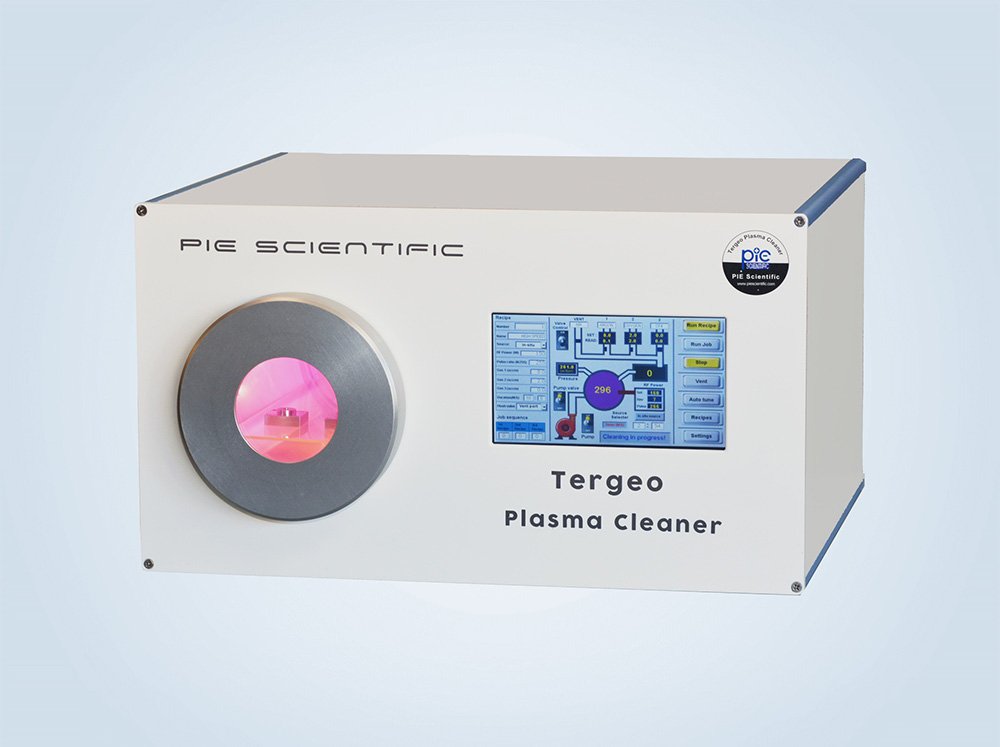
 Which Tergeo fits your lab?
Plasma etchers and plasma etching systems
Tergeo plasma etchers remove organics, polymers, thin films and 2D layers with oxygen, fluorine and hydrogen plasma — with etch rates you can dial from more than 200 nm/min down to below 0.01 nm/min.
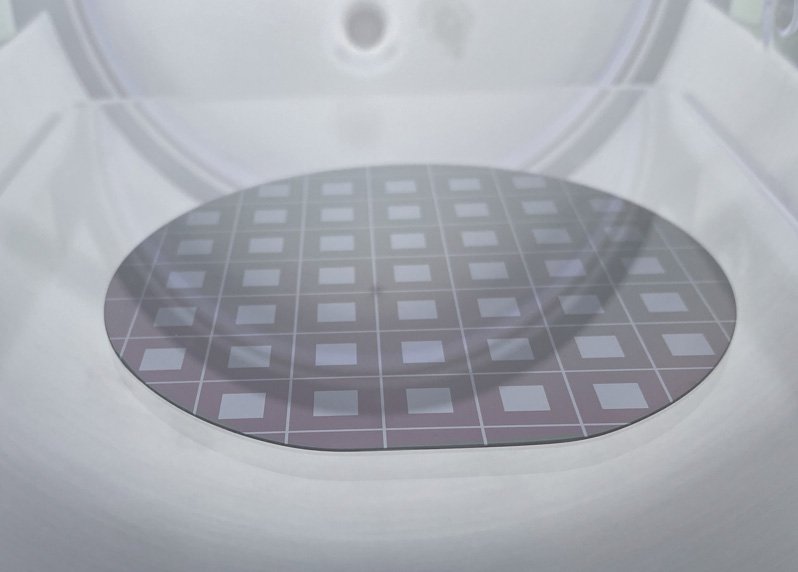
What you can etch with a Tergeo plasma etcher
| Material | Plasma | Typical use |
|---|---|---|
| Photoresist, SU-8, polyimide, parylene | O₂ (O₂ + CF₄ for faster rates) | Ashing & stripping, descum, thinning |
| Polymers and organic films | O₂, air, Ar + O₂ | Surface etching, roughening, residue removal |
| Silicon, SiO₂, Si₃N₄ | CF₄, SF₆ (+ O₂) | Thin-film removal, isotropic silicon etching |
| Graphene, MoS₂ and other 2D materials | O₂, H₂, CF₄, SF₆ — downstream & pulsed | Patterning, layer thinning, controlled defects — see graphene and 2D materials |
| Carbon contamination & capping layers | O₂, Ar + O₂, H₂O | Failure analysis, TEM sample preparation (Tergeo-EM) |
| Encapsulants and molding compounds | O₂, O₂ + CF₄ | Decapsulation and device encapsulation work |
Tergeo systems are designed for chemical and lightly ion-assisted (largely isotropic) plasma etching. For deep, high-aspect-ratio silicon trenches you need a dedicated reactive-ion etcher — ask us and we will tell you honestly which tool fits.
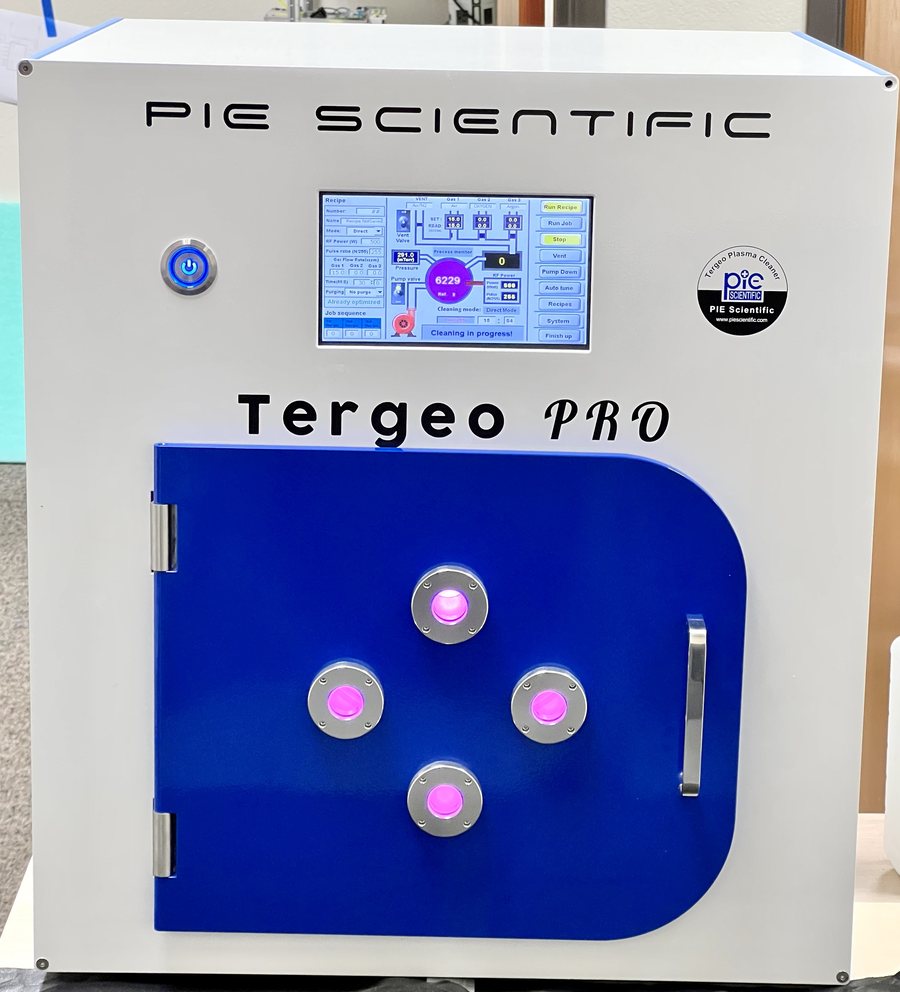
Tergeo-Pro: an 8″ plasma etching system on the bench
The Tergeo-Pro takes the Tergeo recipe control into a Ø230 × 340 mm quartz chamber with a front-loading door — enough for one 8″ wafer, a 4″/6″ wafer boat or a batch of parts and PCBs.
- 150, 300 or 500 W at 13.56 MHz with automatic matching
- Continuous plasma for fast etching; pulsed plasma for gentle, low-damage work
- Up to three MFC gas lines — O₂, Ar, N₂, H₂, CF₄, SF₆ and mixtures
- Real-time plasma intensity sensor and 20-recipe library
Which type of plasma etcher do you need?
An honest comparison — the right tool depends on whether you need isotropic material removal or deep, vertical features.
| Etch system type | How it etches | Good for | PIE option |
|---|---|---|---|
| Tabletop chemical / ion-assisted etcher | Radicals plus moderate ion energy; largely isotropic | Organics, resist, parylene, polyimide, thin Si-based films, 2D materials, decapsulation, failure analysis | Tergeo, Tergeo-Plus, Tergeo-Pro |
| Downstream (remote) etcher | Radicals only, no ion bombardment | Gentle descum, graphene and ESD-sensitive devices | Downstream mode on Tergeo and Tergeo-Plus |
| Reactive-ion etcher (RIE / ICP-RIE) | Directional ion bombardment | Anisotropic pattern transfer, vertical sidewalls | Not a Tergeo application — we will tell you if you need one |
| Deep RIE (Bosch) | Alternating etch/passivation | Deep, high-aspect-ratio silicon trenches | Not a Tergeo application |
From aggressive etching to atomic-scale gentleness
Direct mode for speed
Samples sit in the capacitively coupled plasma; ions and radicals together give the highest etch rates.
Pulsed plasma
Duty cycle down to below 1% stretches the intensity range by 100× — slow, controllable etching of monolayers.
Downstream mode
Radicals only, no ion bombardment — for ESD-sensitive devices, graphene and ultrathin films.
Plasma intensity sensor
Quantitative feedback to reproduce etch conditions and spot the end point when organic layers clear.
Up to 500 W at 13.56 MHz
Tergeo-Plus and Tergeo-Pro power options for thick resists and larger loads.
Clean quartz chamber
External electrodes keep metal sputtering out of your devices.

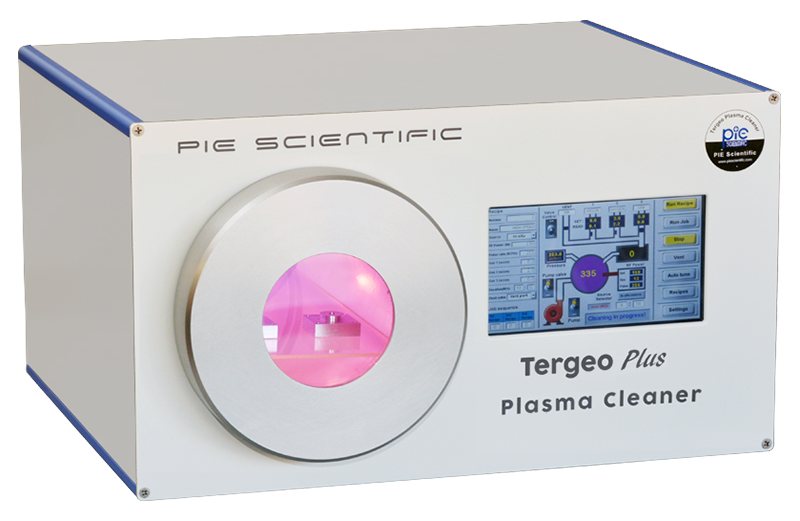

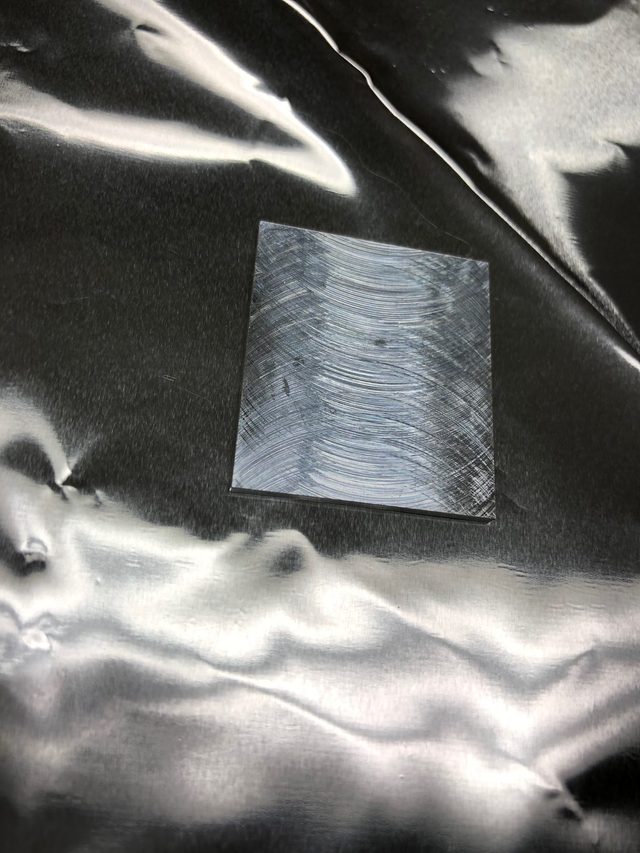
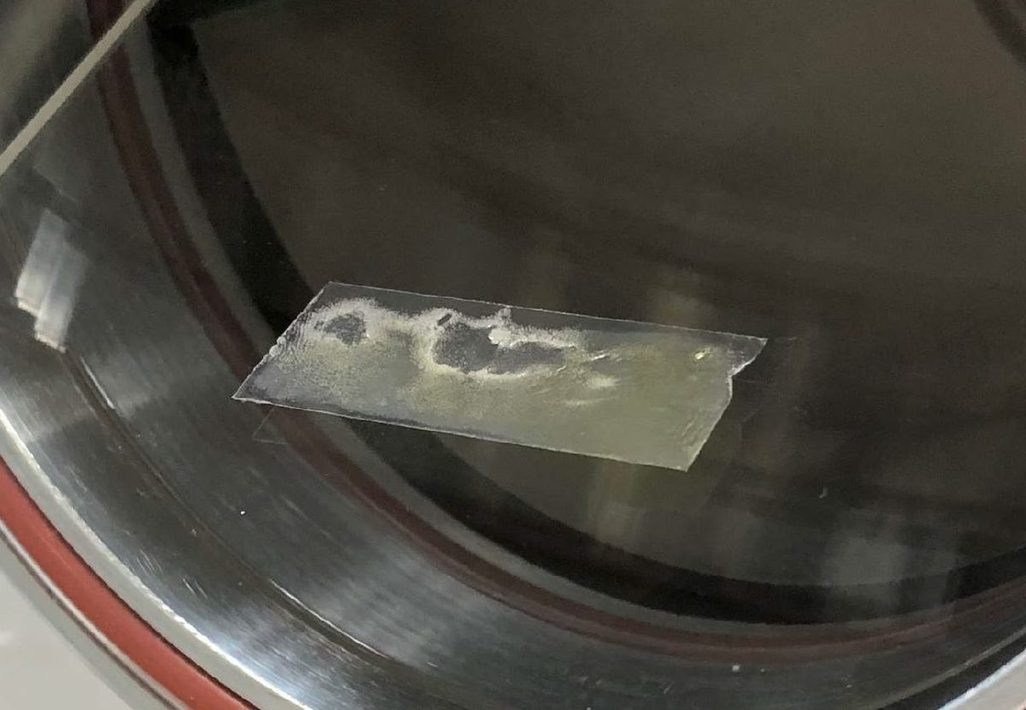
Plasma deprocessing application notes
Plasma etching questions
What is plasma etching?
Plasma etching removes material with reactive species from a gas plasma. Oxygen radicals convert organics into CO₂ and H₂O; fluorine radicals from CF₄ or SF₆ convert silicon compounds into volatile SiF₄. Ions add a physical component that speeds up the reaction.
What is the difference between a plasma etcher and a plasma cleaner?
The same hardware. Cleaning removes nanometres of contamination; etching removes a controlled thickness of material. Tergeo systems switch between the two by changing gas, power, pulse ratio and mode in the recipe.
How much does a plasma etcher cost?
Tergeo plasma etchers are quoted per configuration — chamber size, RF power (75–500 W), gas lines (O₂, CF₄, SF₆, H₂, Ar) and pump. Academic and start-up discounts are available; request a quote.
Can a Tergeo plasma etcher etch silicon?
Yes, with CF₄ or SF₆ (optionally mixed with O₂) for thin-film removal and isotropic etching. Deep anisotropic trench etching requires a dedicated RIE/DRIE tool.
How do I control etch depth on graphene and 2D materials?
Use downstream mode with pulsed, low-power plasma and short times; the plasma intensity sensor helps you repeat the exact conditions. We can share starting recipes.
Not sure which plasma cleaner fits your process?
Tell us your samples, size and process gas. Our engineers reply within one to two business days with a recommendation and a quote.