
 Which Tergeo fits your lab?
Gentle plasma cleaning of fragile TEM carbon grids
Ultrathin carbon support films are etched by the same plasma that cleans them. This note shows how the downstream (remote) mode and pulsed plasma of the Tergeo-EM keep the etch rate low enough to clean 20 nm and 3 nm carbon grids for minutes — using only room air.
- 20 nm carbon: intact after 20 min
- 3 nm lacey carbon: no rupture in 6 min
- Room air only
Two ways to make the plasma gentle enough for a 3 nm film
A plasma cleans by oxidizing hydrocarbons, but a carbon support film is also carbon. To clean it without destroying it, the etch rate has to be brought down by orders of magnitude, and ion bombardment, electron heating and UV have to be kept away from the film.
Downstream (remote) mode
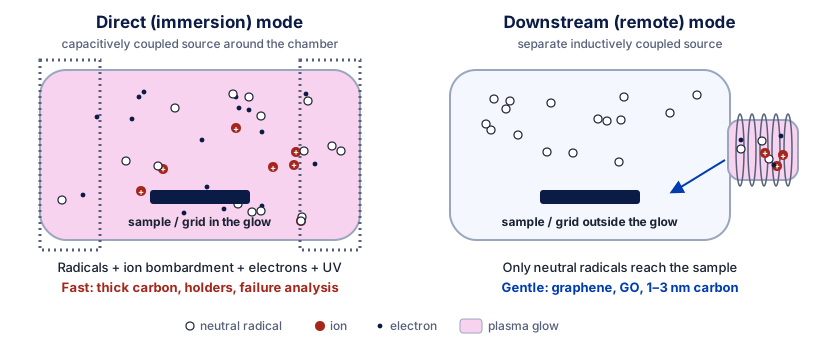
In the conventional direct mode, the grid sits inside the plasma glow. It receives reactive radicals, energetic ions, electrons and UV, which gives fast cleaning but also fast etching. In Tergeo-EM's downstream mode, the plasma burns in a separate inductively coupled source. Only neutral radicals diffuse into the sample chamber and react gently with the grid surface. There is no ion sputtering, electron heating or UV.
Pulsed plasma
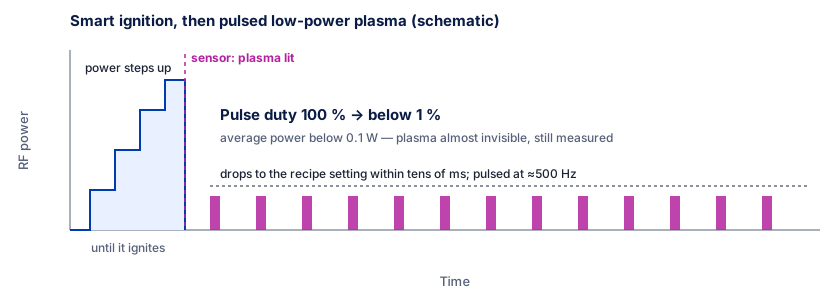
Turning down RF watts only goes so far, because a plasma needs more power to ignite than to keep running. Tergeo-EM also pulses the plasma at about 500 Hz, with a duty adjustable from 100 % (continuous) to below 1 %. This brings the average power below 0.1 W. Its plasma sensor confirms ignition and then drops the power to the recipe setting, so even an almost invisible plasma starts reliably. The sensor also gives a quantitative intensity reading for each recipe.
Measuring film thinning by optical transmission
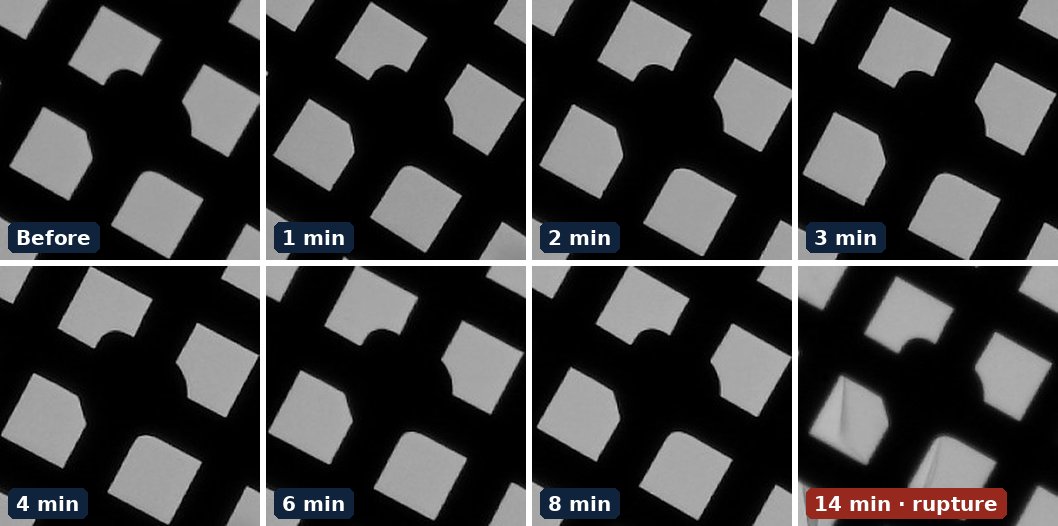
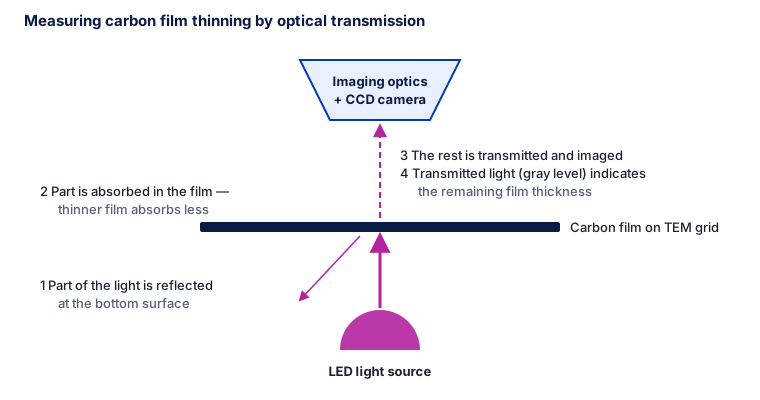
Each grid was treated in a Tergeo-EM in 1- or 2-minute steps and imaged after each step in an optical microscope in transmission mode. Light from an LED below the grid is partly reflected at the film's bottom surface and partly absorbed in the film. The rest is collected by the imaging optics and CCD camera. As plasma thins the carbon film, it absorbs less, so the gray level of the grid squares rises.
| Grid | Film |
|---|---|
| Ted Pella 01843 | Pure carbon film, no Formvar layer, ≈15–25 nm thick |
| Ted Pella 01822 | Ultrathin lacey carbon, ≈3 nm thick |
20 nm pure carbon film: 20 minutes without damage
| Grid | Ted Pella 01843, ≈20 nm pure carbon |
|---|---|
| Mode | Downstream (remote) |
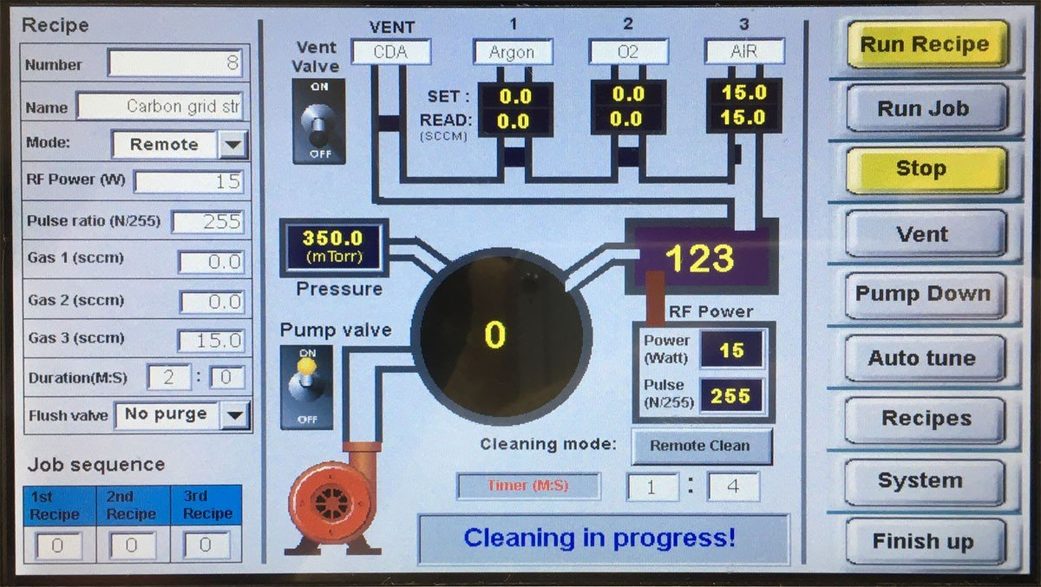
| RF power | 15 W, continuous (100 % duty) |
| Gas | Room air, 15 sccm |
| Plasma intensity reading | 123 |
| Result | Film intact after 20 minutes |
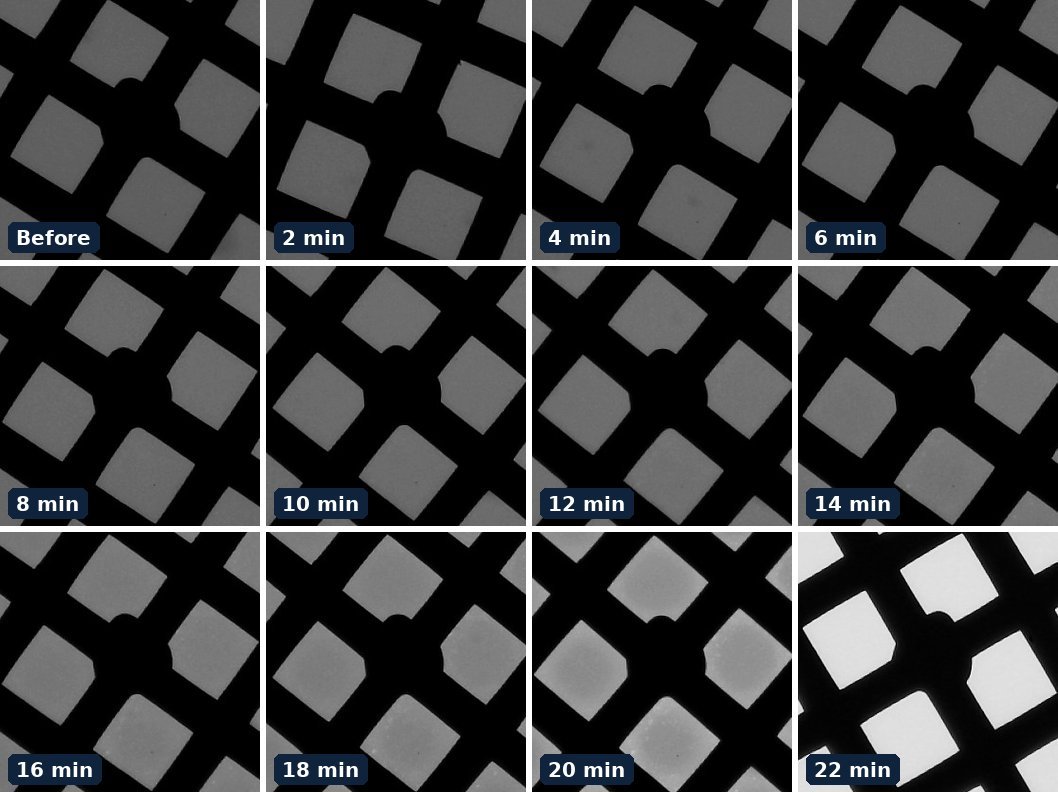
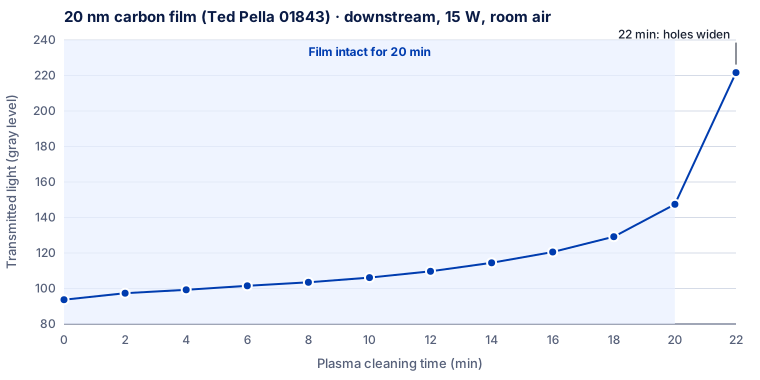
Transmitted light rose slowly and steadily for 18 minutes, showing a slow, even thinning of the film. The steep rise after 18–20 minutes is probably the holes in the holey film starting to widen. Typical grid cleaning steps are far shorter than 20 minutes, so a 20 nm grid can be cleaned many times, and the treatment could be extended further if needed.
3 nm ultrathin lacey carbon: pulsed downstream plasma
| Grid | Ted Pella 01822, ≈3 nm ultrathin lacey carbon |
|---|---|
| Mode | Downstream (remote) |
| RF power | 10 W, pulsed at 25 % duty |
| Gas | Room air, 15 sccm |
| Plasma intensity reading | 9 — an extremely weak plasma |
| Result | No rupture through 6 minutes; first local ruptures after 8 minutes; center of the film ruptured after 14 minutes |
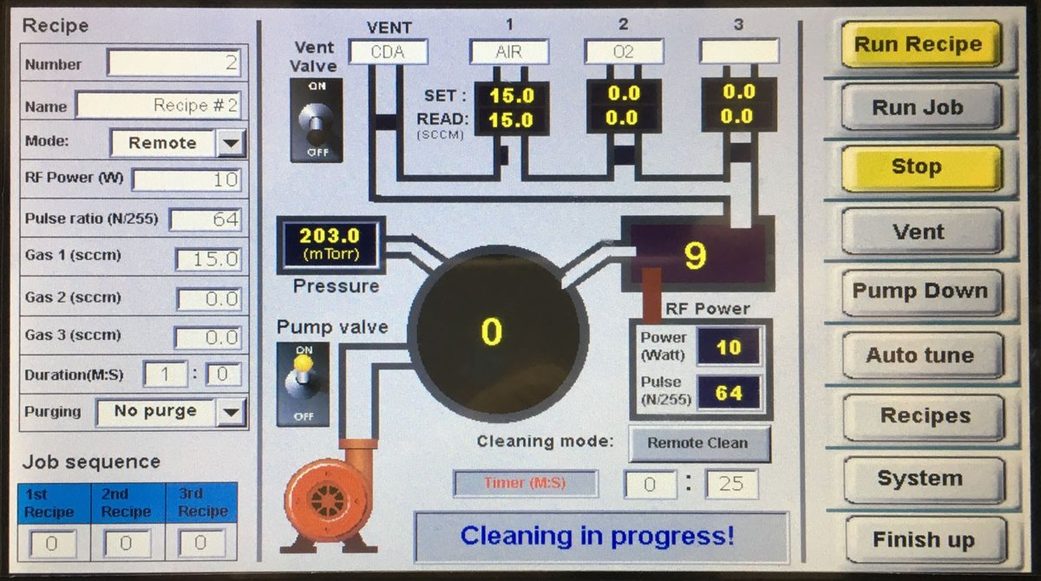
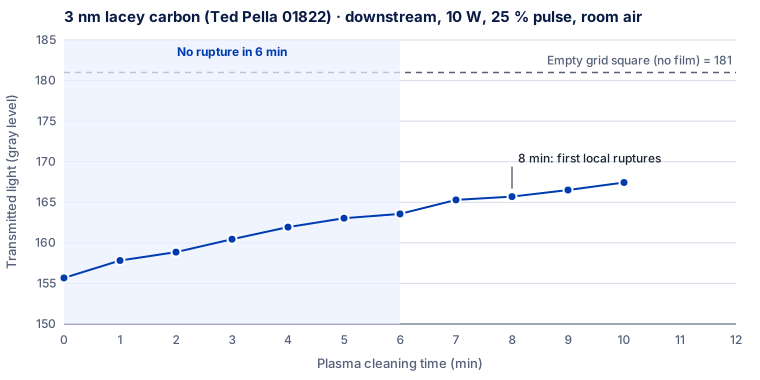
An ultrathin 3 nm film needs a much weaker plasma than a 20 nm film. With pulsed downstream plasma, the transmitted light rose by only about 1 gray level per minute — far below the empty-square level of 181. The film was cleaned for 6 minutes without rupture. Ruptures appeared in some areas after 8 minutes, and the center ruptured after 14 minutes, even though the film was not fully etched away.
What the study shows
Minutes, not seconds
With downstream mode and pulsed plasma, the Tergeo-EM cleans fragile carbon grids for minutes without rupturing the film.
Repeated cleaning
A regular 20 nm carbon grid can easily be cleaned many times. Even a 3 nm grid can be cleaned more than once at 10 W and 25 % pulse duty.
A number for every recipe
The plasma intensity sensor measures the plasma in real time, which makes it easy to set up and reproduce a recipe for each grid type.
Room air is enough
Oxygen, hydrogen and argon are supported, but ambient air alone cleans fragile carbon grids — no gas cylinders needed.
Faster when you need it
Combine direct or downstream mode, RF power and pulse duty to raise or lower the etch rate across more than three orders of magnitude.
Start gentle
For a new grid type, start with a pulsed downstream recipe and a short time, then increase it while watching the intensity reading.
Related: Tergeo-EM TEM plasma cleaner · TEM, SEM & FIB sample cleaning · Plasma processing for 2D materials
Plasma cleaning carbon grids: common questions
Why do ultrathin carbon grids break in a plasma cleaner?
Oxygen-containing plasma removes hydrocarbons by oxidizing them, and the support film is carbon too. In direct mode the film also takes ion bombardment, electron heating and UV, so a 1–3 nm film can be etched through in seconds. Downstream and pulsed plasma reduce the etch rate by orders of magnitude.
What recipe should I start with for a 3 nm carbon grid?
In this study: downstream mode, 10 W, 25 % pulse duty, 15 sccm room air, giving a plasma intensity reading of about 9. The film survived 6 minutes without rupture, so a short cleaning or activation step leaves a wide safety margin.
Can I clean the same grid more than once?
Yes. A 20 nm carbon grid survived 20 minutes of downstream room-air plasma, and a 3 nm grid 6 minutes of pulsed downstream plasma, so both can be cleaned several times.
Do I need oxygen or hydrogen gas?
No. Both tests used only room air. Tergeo-EM also supports O₂, H₂, Ar, N₂, water vapor and mixtures for other applications.
Not sure which plasma cleaner fits your process?
Tell us your samples, size and process gas. Our engineers reply within one to two business days with a recommendation and a quote.