
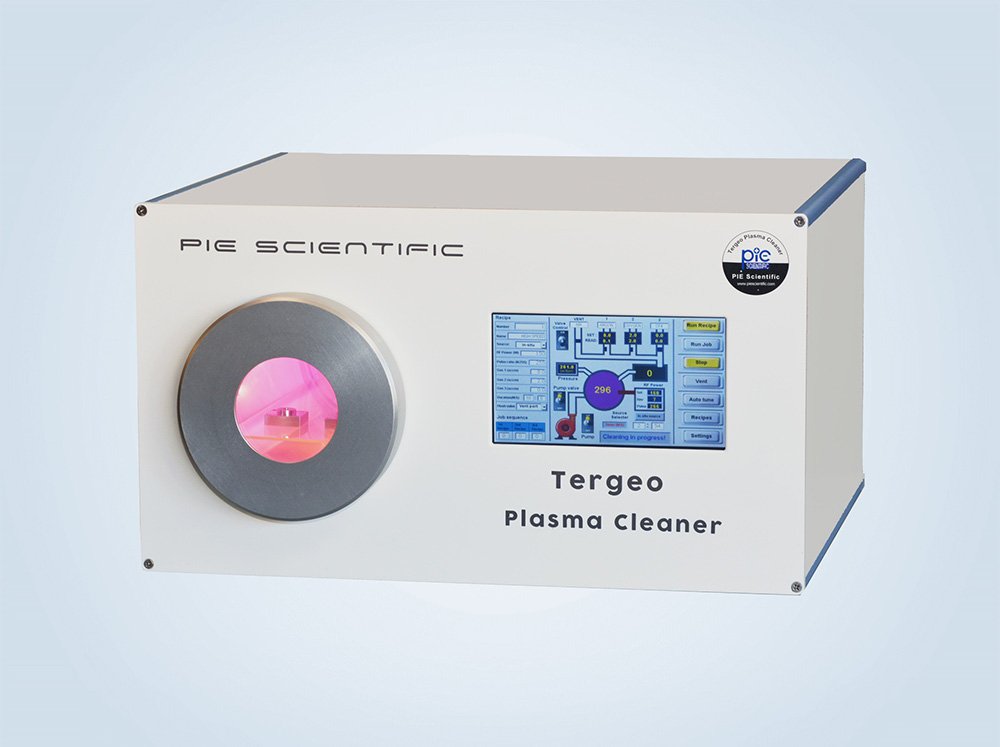
 Which Tergeo fits your lab?
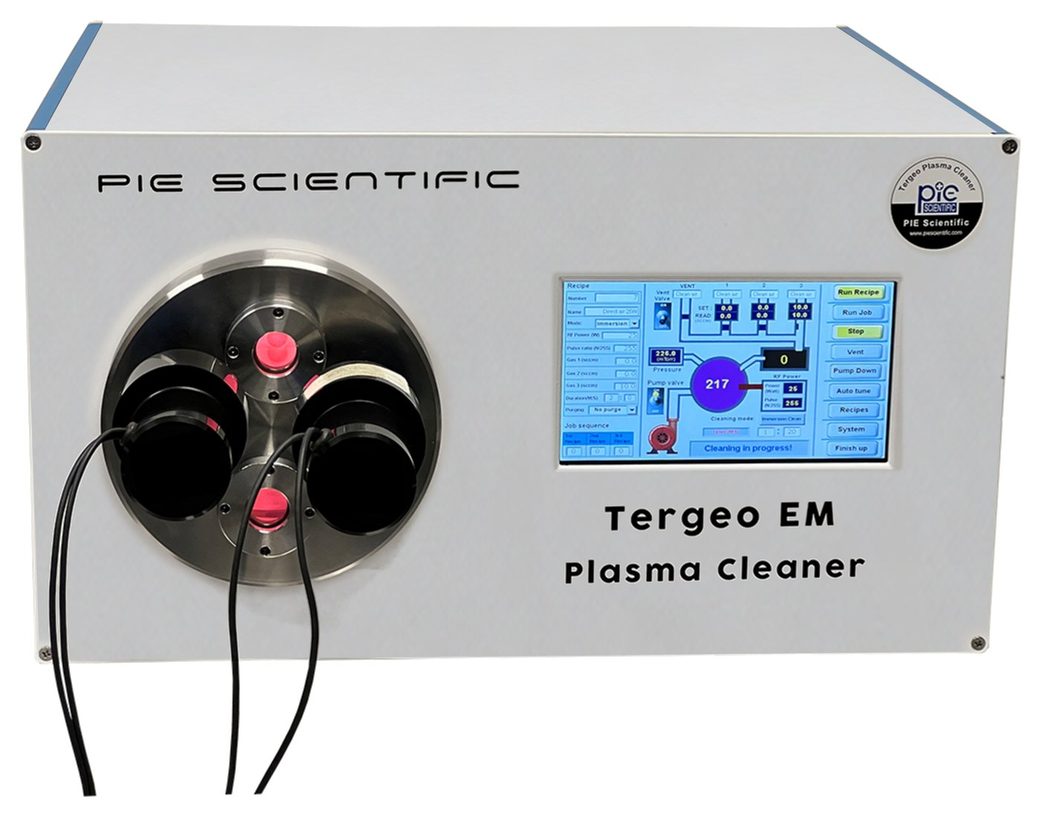
Tergeo-EM TEM plasma cleaner for holders, samples and cryo-EM grids
The Tergeo-EM plasma cleaner cleans TEM specimen holders and TEM/SEM samples, and activates cryo-EM grids and in-situ chips. Unlike conventional TEM plasma cleaners, it is gentle enough for monolayer graphene, graphene oxide and ultrathin (1–3 nm) carbon grids, and fast enough to remove a thick carbon deposit in minutes.
Plasma cleaning graphene, graphene oxide and ultrathin carbon TEM grids
The support films on these grids — graphene, graphene oxide and ultrathin carbon — can be just one to a few atomic layers thick, and the oxygen radicals that clean them also etch them. In many conventional TEM plasma cleaners, the grid sits inside the plasma, and the system needs relatively high RF power to ignite and sustain it — by the time the plasma lights, it is already too strong for these films. Nor is there a way to measure how strong the plasma actually is. Tergeo-EM addresses all three: the grid can sit downstream, outside the plasma; pulsed mode makes the plasma extremely gentle (duty cycle down to below 1%, with reliable ignition at under 0.1 W average); and a built-in sensor measures plasma intensity in real time, so you can tune a recipe’s strength and speed instead of guessing. 3 nm lacey carbon was cleaned for more than 10 minutes without rupture. These features are also very useful for 2D materials research. The same system can also run at full strength to remove heavy carbon deposition and ash away polyimide in failure analysis, and lets you make cryo-EM grids hydrophilic or give them a positive or negative surface charge, repeatably.
What makes Tergeo-EM better than other TEM plasma cleaners
Six design features, not found together in any other TEM plasma cleaner we know of, give Tergeo-EM more than three orders of magnitude of etch-rate control — from >200 nm/min to <0.01 nm/min — in one benchtop system.
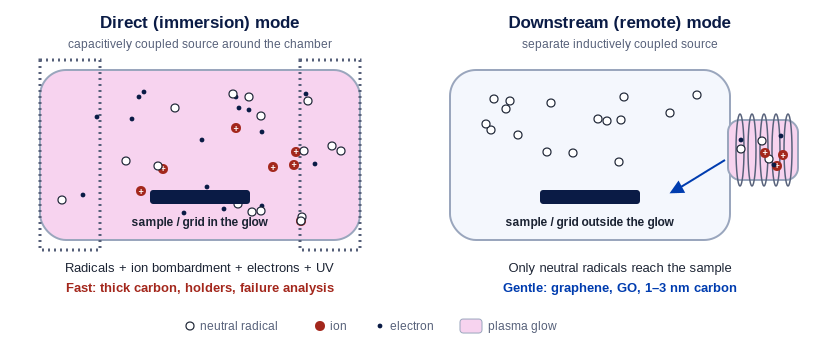
1. Two plasma sources in one system
A capacitively coupled direct source fills the sample chamber for fast cleaning. A separate inductively coupled downstream source sends only neutral radicals to the grid — no ion sputtering, electron heating or UV.
2. Continuous or pulsed plasma
Besides RF power, the recipe sets the pulse duty from 100 % (continuous) to below 1 % at about 500 Hz. Average power can go below 0.1 W, and intensity follows the duty far more linearly than it follows RF watts, over two orders of magnitude.
3. Smart low-power ignition
If a low-power recipe doesn't light, Tergeo-EM raises the power until the sensor sees plasma, then drops back to the recipe setting within tens of milliseconds. A sub-watt recipe starts the same way every time, with no manual tweaking.
4. Real-time plasma intensity sensor
A built-in optical sensor shows how strong the plasma actually is. For example, a gentle 3 nm grid recipe reads 9 and a 20 nm grid recipe 123. Use the number to set up recipes, transfer them between users and check that they behave the same every day.
5. Every common process gas — plus water vapor and room air
Run argon, oxygen, hydrogen, nitrogen, CF₄ or SF₆, or mix up to three gases at any ratio with integrated MFCs (Ar + O₂, Ar + H₂, H₂ + O₂ and more). Tergeo-EM can also meter water vapor (0–10 sccm, no heating), which adds dense OH groups for super-hydrophilic grids — safer than H₂ + O₂ and more repeatable than room humidity. It can even run on plain room air when no gas cylinder is at hand.
6. Low maintenance, low cost of ownership
No consumable parts inside the system, plasma-resistant FEP-encapsulated vacuum seals and electrodes outside the quartz chamber — many Tergeo-EM systems have run for 10 years without scheduled maintenance. The external dry pump can be serviced by you or the pump maker, and built-in self-diagnostics tell you what to check.
Tergeo-EM vs. conventional TEM plasma cleaners
Conventional TEM plasma cleaners were designed mainly for cleaning holders and samples. They do that well, but have few ways to make the plasma weaker or to measure it.
| Typical conventional TEM plasma cleaner | Tergeo-EM | |
|---|---|---|
| Plasma source | One source — direct or remote | Direct (CCP) and downstream (ICP), chosen per recipe |
| How plasma strength is set | RF power and time | RF power in 1 W steps, plus pulse duty 100 % → <1 % |
| Lowest stable plasma | Limited by the power needed to ignite | Below 0.1 W average, with automatic ignition |
| Plasma measurement | Forward / reflected RF power only | Quantitative plasma intensity reading in real time |
| Hydrophilic grid chemistry | Room humidity, Ar/O₂ premix or H₂ + O₂ cylinders | Room air or metered water vapor; H₂, O₂, Ar, N₂ also available |
| Etch-rate range | Mostly fast cleaning | >200 nm/min down to <0.01 nm/min |
| Typical use | Holder and sample cleaning | Holders, samples and fragile grids, plus thick e-beam carbon removal, failure-analysis decapping with CF₄/SF₆ and vacuum storage of two holders |
| Maintenance | Varies by model | No consumable parts inside; no scheduled maintenance; external dry pump you can service yourself |
Based on published specifications of common TEM plasma cleaners. Individual models differ — ask us to compare a specific system.
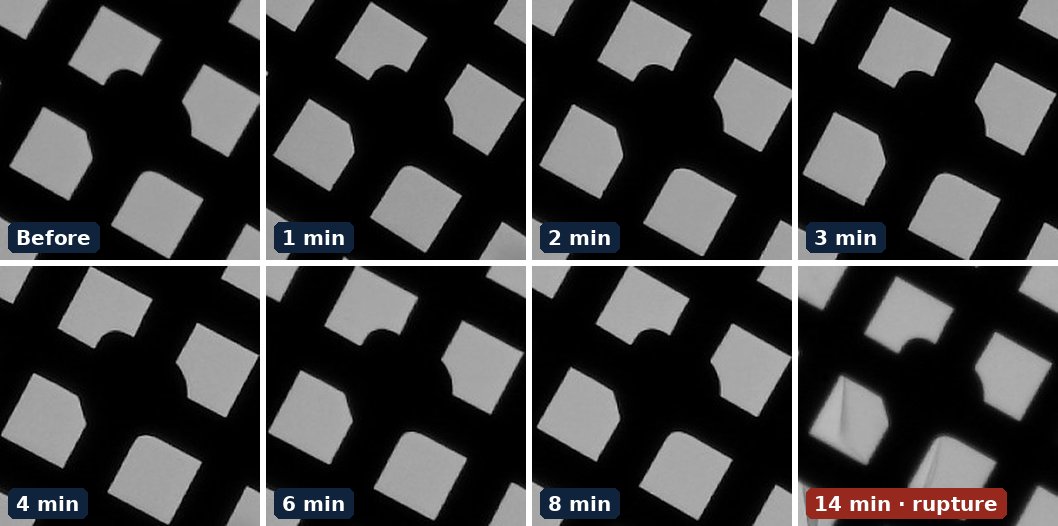
Carbon grid data: 3 nm carbon cleaned for 10 minutes without rupture
With pulsed downstream plasma on room air, a 3 nm ultrathin lacey carbon grid was cleaned for 10 minutes without rupture, and a 20 nm carbon grid stayed intact for 20 minutes. The application note shows the method, recipes, time-lapse images and data.
Plasma cleaner for TEM specimen holders and samples
Hydrocarbons on a TEM specimen holder or sample crack under the electron beam into a carbon film. That causes the familiar contamination squares in STEM, loss of resolution and drifting EELS backgrounds. Plasma cleaning the holder tip and sample just before insertion removes those hydrocarbons, so the column stays clean and high-resolution sessions last longer.
- Insert the holder through the front door — each door takes two standard specimen holders. Swap doors in about 10 seconds to support other holder types.
- Run a stored recipe: gas mix, RF power, pulsed or continuous, direct or downstream mode, time and purge. A typical holder clean takes 10–120 s.
- Compatible with all major microscope brands — Thermo Fisher, JEOL, Hitachi, TESCAN, Zeiss/LEO — with custom adapters for specialized TEM systems.
- Remove the front door to load SEM/TEM samples or grid boxes directly into the chamber.
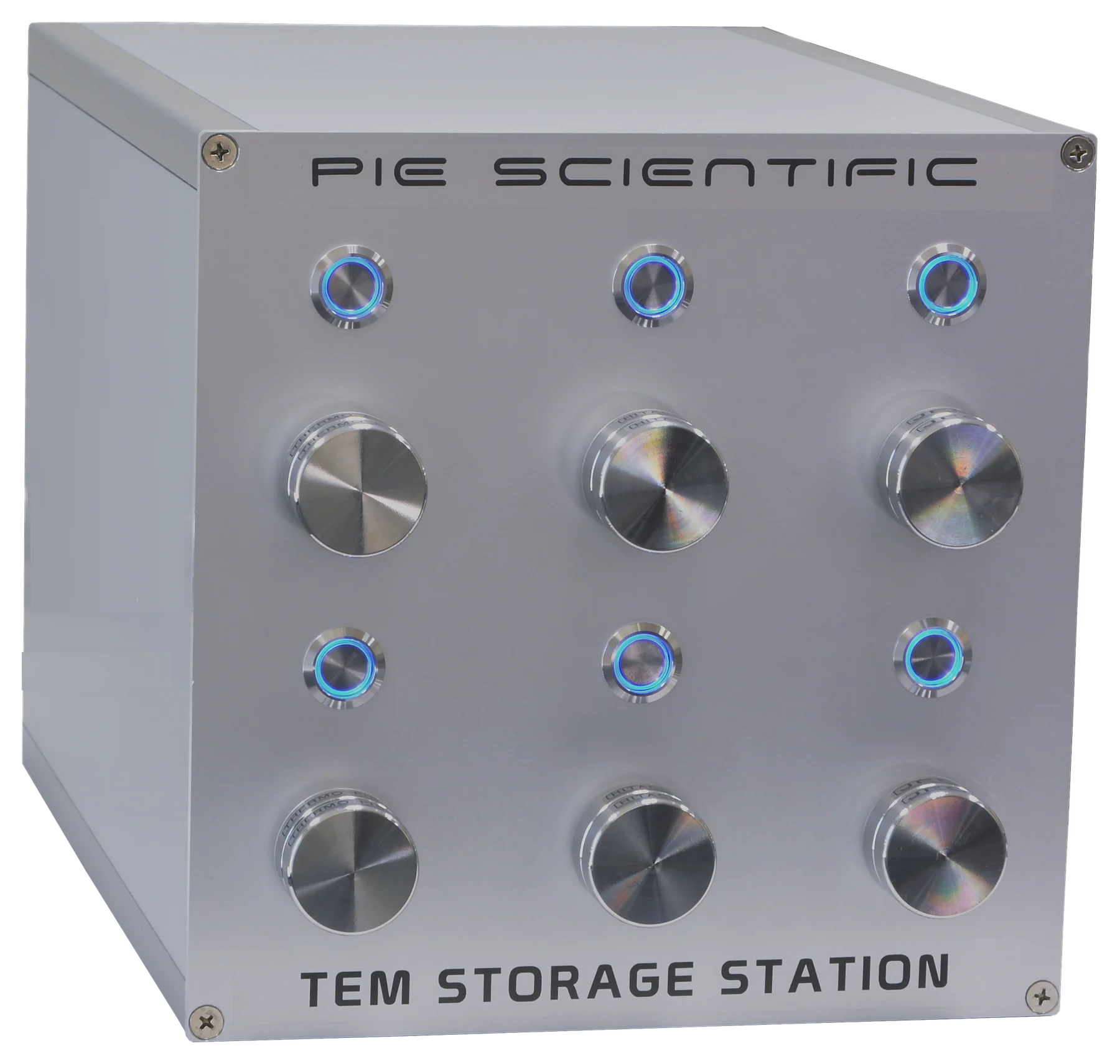
- Between sessions, keep the two holders under vacuum in the chamber. For more holders, use the TEM holder pumping & storage station or the TEM CUBE.
Typical Tergeo-EM tasks
- Holder tips and samples before every high-resolution or STEM session
- Aberration-corrector tuning samples — regular gentle cleaning
- Graphene, graphene-oxide and ultrathin carbon grid activation for cryo-EM
- Activating in-situ / liquid-cell chips
- Removing thick e-beam-induced carbon deposits
- Removing capping layers for failure analysis
Application note: fragile carbon grids
TEM, SEM & FIB sample cleaning
Tergeo-EM specifications
| Holder compatibility | All major microscope brands: Thermo Fisher, JEOL, Hitachi, TESCAN, Zeiss/LEO and more; two standard specimen holders per front door; custom adapters for specialized TEM systems |
|---|---|
| Sample chamber | Quartz, 110 mm (4.3″) inner diameter × 280 mm (11″) deep; 100 × 250 mm quartz sample tray |
| Plasma sources | Direct mode: capacitively coupled, external electrodes (no electrode sputtering). Downstream mode: separate inductively coupled source. |
| RF power | 13.56 MHz, 0–75 W or 0–150 W in 1 W steps; fully automatic impedance matching |
| Pulsed plasma | Duty adjustable from 100 % (continuous) to below 1 %, about 500 Hz; average power below 0.1 W; smart automatic low-power ignition |
| Etch-rate range | From more than 200 nm/min to less than 0.01 nm/min |
| Plasma diagnostics | Real-time quantitative plasma intensity sensor |
| Process gases | Room air, Ar, O₂, H₂, N₂, H₂O vapor (0–10 sccm kit), CF₄, SF₆; two MFC gas lines standard, third optional; mix at any ratio; separate vent gas input |
| Pressure sensor | Full-range, corrosion-resistant (platinum filament), compatible with CF₄ and SF₆ plasma |
| Control | 7″ LCD touchscreen (10″ optional), 20-recipe library with recipe lock, 3-recipe job sequence, self-diagnostics; optional PC control |
| Vacuum pump | External oil-free dry pump (Edwards), switched automatically by the system |
| Size and weight | W 450 × H 250 × D 430 mm (17.7 × 9.8 × 17″); 20 kg (45 lb) without pump |
| Certifications | UL 61010-1:2012 R4.16 · CAN/CSA-C22.2 61010-1-12+GI1+GI2 (R2017) · IEC 61010-1:2010 · CE and TÜV Rheinland marked · NRTL compliant |
Used by TEM, SEM and cryo-EM labs worldwide
MIT, Harvard, Caltech, UC Berkeley, Stanford, UIUC, NIH, EAG Laboratories, McGill University, CNRS, multiple Max Planck Institutes, University of Leeds, Tsinghua University, NUS, Seoul National University, Australian National University and many more. More than half of our Tergeo-EM sales come from former users who moved to new institutions, and from referrals.
Publications that mention Tergeo (Google Scholar)
I find it quite flexible for TEM holders, holders with samples, grids, etc. I have used it successfully with a very gentle remote plasma source setting to regularly clean the tuning samples for aberration-corrected STEM.
 Dr. James C. MabonUniversity of Illinois at Urbana-Champaign
Selected publications
- High-speed high-resolution data collection on a 200 keV cryo-TEM — IUCrJ, 2022
- 2.5 Å-resolution structure of human CDK-activating kinase bound to the clinical inhibitor ICEC0942 — Biophysical Journal, 2021
- Efficient graphene oxide coating improves cryo-EM sample preparation and data collection from tilted grids — bioRxiv, 2021
- Cryo-EM structures of the SARS-CoV-2 endoribonuclease Nsp15 reveal insight into nuclease specificity and dynamics — Nature Communications, 2021
- Efficacy of boron nitride encapsulation against plasma-processing of 2D semiconductor layers — J. Vac. Sci. Technol. A, 2021
- Cryo-EM structures of an insecticidal Bt toxin reveal its mechanism of action on the membrane — Nature Communications, 2021
- Calcineurin-fusion facilitates cryo-EM structure determination of a Family A GPCR — PNAS, 2024
Keep cleaned holders clean

TEM plasma cleaner questions
How is Tergeo-EM different from a conventional TEM plasma cleaner?
It combines a direct and a downstream plasma source, continuous and pulsed operation down to below 0.1 W average, automatic low-power ignition, a real-time plasma intensity sensor, and metered water vapor in one system. Together these make the plasma both weaker and measurable, which is what fragile graphene, graphene-oxide and 1–3 nm carbon grids need. The same system also runs fast direct-mode recipes for holders and thick carbon.
Will plasma damage graphene or ultrathin carbon grids?
Not when the dose is controlled. With pulsed downstream plasma, a 3 nm carbon grid was cleaned for 10 minutes without rupture — see the carbon grid application note.
Do I need hydrogen or other gas cylinders for cryo-EM grids?
No. Gentle grid recipes run on room air, and the water-vapor kit makes grids super-hydrophilic without flammable H₂ + O₂ mixtures. Ar, O₂, H₂, N₂ and mixtures are supported if you want them.
Can Tergeo-EM replace a glow-discharge unit for cryo-EM grids?
Yes. It activates grids, renders them hydrophilic or creates positive or negative surface charges, with recipe control and a plasma intensity reading for repeatability.
Which holders fit?
Standard holders from Thermo Fisher (FEI), JEOL, Hitachi, TESCAN and Zeiss/LEO, two per front door. Custom adapters are available for specialized systems — tell us your holder model.
Not sure which plasma cleaner fits your process?
Tell us your samples, size and process gas. Our engineers reply within one to two business days with a recommendation and a quote.