
Vacuum plasma cleaners
A vacuum plasma cleaner removes organic contamination and activates surfaces using a gas plasma generated at low pressure inside a sealed chamber. Here is what happens in each step, which gases to use, and how to choose a system.

In short
A vacuum plasma cleaner (low-pressure plasma cleaner) pumps a chamber down, fills it with a small, controlled flow of gas such as oxygen or argon, and applies radio-frequency power. The gas becomes a glowing plasma of ions, electrons and reactive radicals. Radicals turn organic films into CO₂ and H₂O that the pump removes, and they leave reactive groups (such as –OH) on the surface — so the part ends up both clean and activated for bonding, coating or printing.
Basics: what is plasma cleaning · Plasma cleaner & asher design guide
What happens inside a vacuum plasma cleaner
Pump down
The vacuum pump removes air and moisture. Tergeo systems need a pump that reaches 50 mTorr or lower.
Gas in
Mass flow controllers meter up to three gases; the chamber settles at a stable process pressure.
Plasma on
13.56 MHz RF power ignites a glow discharge; automatic matching keeps the power coupled into the plasma.
Surface reactions
Radicals oxidize or reduce contamination into volatile gases; ions break surface bonds; new functional groups form.
Purge & vent
Reaction products are pumped out, the chamber is purged and vented, and the parts are ready.
Why low pressure? At reduced pressure the gas breaks down into plasma with modest power, the plasma fills the whole chamber uniformly, and reactive species reach every surface — including the backs of parts, trenches and channels.
Direct mode vs downstream (remote) mode
Tergeo plasma cleaners have both plasma sources in one chamber, so you choose per recipe.

Direct (immersion) mode
The sample sits inside the plasma. Ions and radicals act together for the highest speed — photoresist ashing faster than 1 µm/min, etching, and removal of thick carbon deposits.

Downstream (remote) mode
Plasma is generated away from the sample and mostly neutral radicals arrive. No ion bombardment and no charging — ideal for 2D materials, ultrathin TEM grids and ESD-sensitive devices. Combine with pulsed plasma for the gentlest treatment.
Which gas should a vacuum plasma cleaner use?
| Gas | What it does | Typical uses |
|---|---|---|
| Oxygen (O₂) | Oxidizes organics to CO₂ and H₂O; adds polar groups | Photoresist ashing, descum, cleaning, PDMS bonding |
| Ambient air | Similar to oxygen plasma; results vary slightly with humidity | PDMS and glass activation, general cleaning |
| Water vapor (H₂O) | Dense OH* radicals; long-lasting hydrophilic surfaces; safer than H₂/O₂ mixtures | Glass and PDMS bonding, cryo-EM grids, sterilization |
| Argon (Ar) | Physical cleaning by ion bombardment, no oxidation | Oxidation-sensitive metals, pre-bond cleaning, mixed with O₂ or H₂ |
| Hydrogen (H₂) / Ar+H₂ | Reduces oxides and removes carbon | Metal and compound-semiconductor surfaces, PTFE treatment |
| Nitrogen (N₂) | Adds nitrogen groups; inert purge | Polymer activation, purging |
| CF₄ / SF₆ | Fluorine radicals etch silicon, SiO₂ and Si₃N₄ | Silicon etching, faster ashing as O₂ + CF₄ |
Vacuum plasma vs atmospheric plasma cleaning
| Vacuum (low-pressure) plasma cleaner | Atmospheric plasma (jet / corona) | |
|---|---|---|
| Coverage | Whole part, all sides, inside holes and channels | Line of sight under the nozzle |
| Gas chemistry | O₂, Ar, H₂, N₂, H₂O, CF₄, SF₆ and mixtures, precisely metered | Mostly air or nitrogen |
| Gentle options | Downstream radicals, pulsed plasma, 1 W power steps | Limited; hot, energetic spot |
| Uniformity & repeatability | High — controlled pressure, flow and power | Depends on distance and scan speed |
| Etching & ashing | Yes | Not practical |
| Throughput | Batch; minutes per cycle including pump-down | Inline, continuous |
| Best for | Labs, R&D, semiconductors, medical devices, microfluidics, electron microscopy | Production lines treating large flat surfaces |
Choosing a pump for a vacuum plasma cleaner
- Oxygen-safe. Use a dry scroll pump rated for oxygen service, or an oil pump filled with inert PFPE oil. Standard hydrocarbon pump oil is not suitable for oxygen plasma.
- Ultimate pressure 50 mTorr or lower.
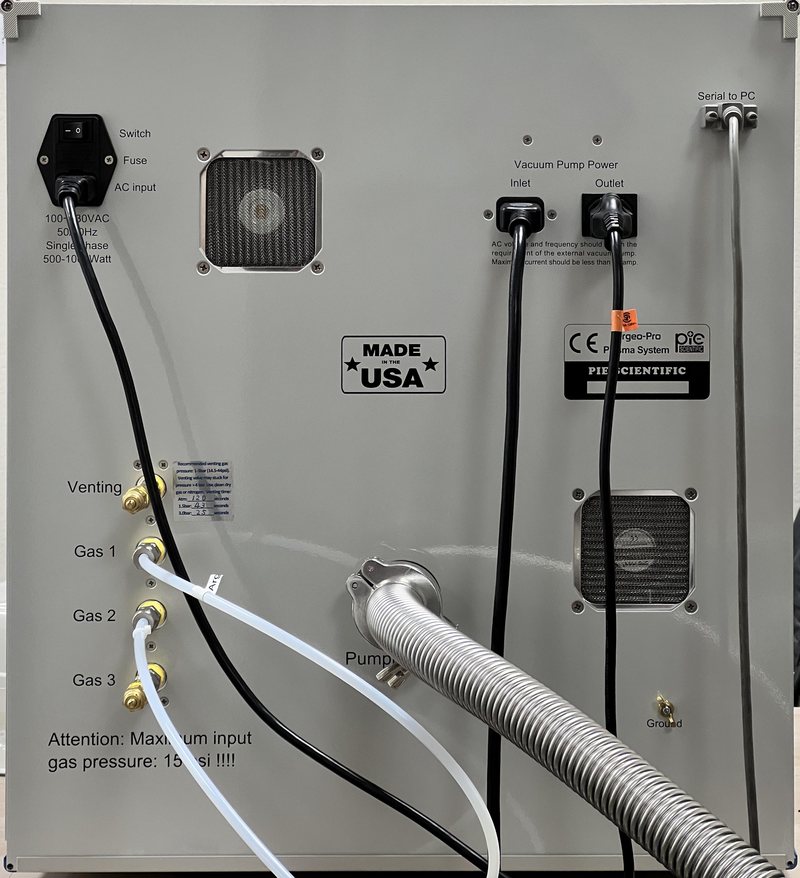
- Pumping speed. At least 2.0 cfm for Tergeo-Plus and 3.5 cfm for Tergeo-Pro.
- Connection. NW/KF25 pumping port; exhaust to a fume line when using fluorine gases.
- Pump control. The pump plugs into a power outlet on the plasma system, which switches it on and off automatically.
We can supply a matched pump with every system.
PIE Scientific vacuum plasma cleaners
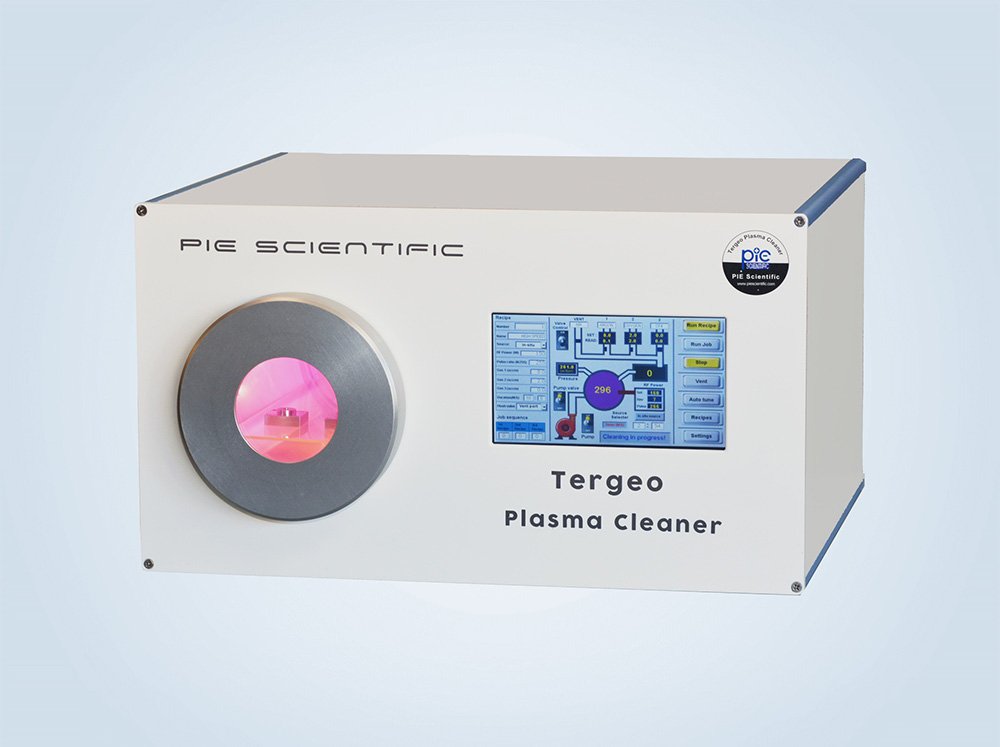
Tergeo tabletop plasma cleaners
Tergeo, Tergeo-Plus and Tergeo-Pro: Ø110 to Ø230 mm quartz chambers, 75–500 W.
Compare models →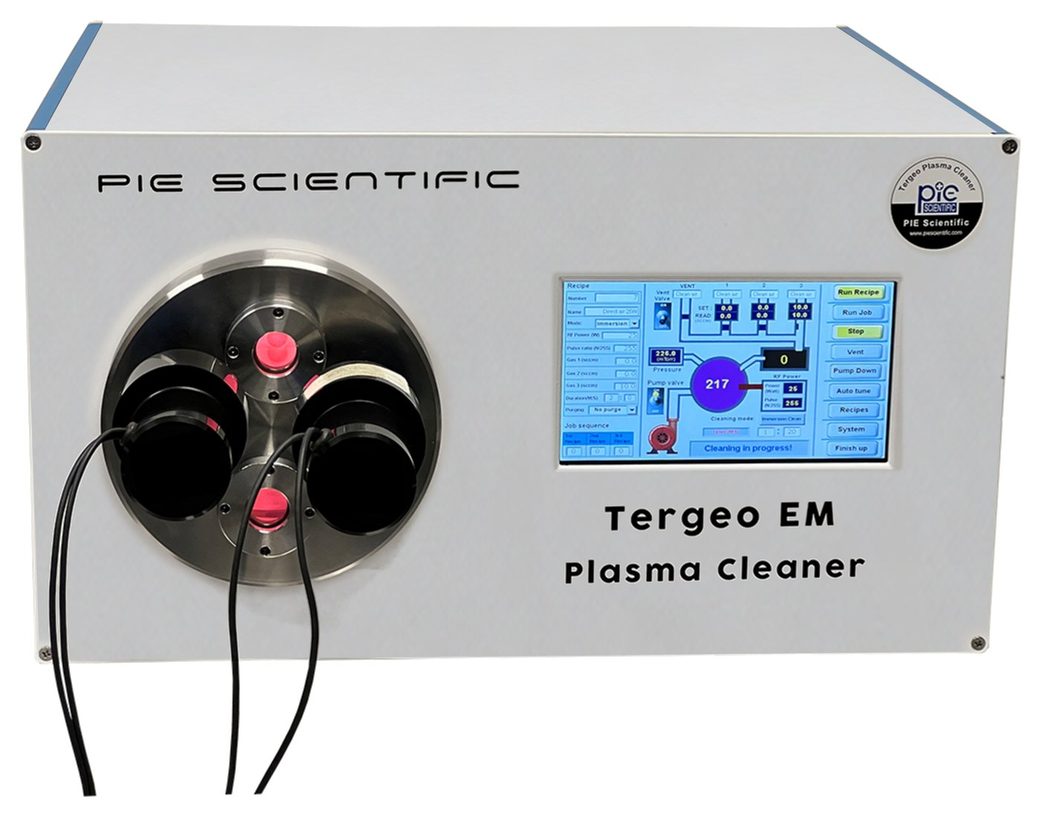
Tergeo-EM
Vacuum plasma cleaner for TEM/SEM holders, samples and cryo-EM grids.
Tergeo-EM →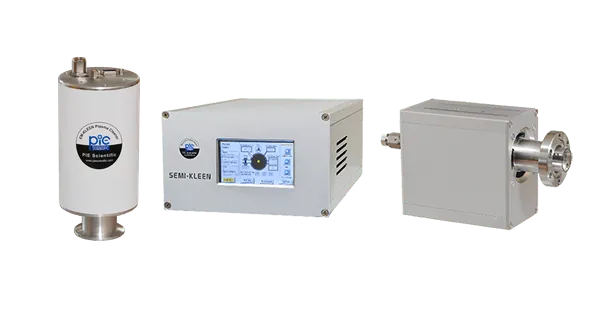
In-situ remote plasma sources
Turn your SEM, FIB, XPS or UHV chamber into a vacuum plasma cleaner.
EM-KLEEN & SEMI-KLEEN →Vacuum plasma cleaner questions
What is a vacuum plasma cleaner?
A machine that cleans and activates surfaces with a gas plasma generated at low pressure inside a vacuum chamber. It removes thin organic contamination without solvents and changes surface chemistry for better bonding, wetting and coating.
How long does a vacuum plasma cleaning cycle take?
The plasma step is usually seconds to a few minutes — for example 10–60 seconds for PDMS activation, or a few minutes to clean carbon from SEM samples. Add pump-down and venting time, which depends on the pump and chamber size.
Will plasma cleaning damage my samples?
Not when the recipe fits the sample. Fragile samples are treated in downstream mode with pulsed, low-power plasma, so only neutral radicals reach them. Tergeo-EM, for example, cleans 1–3 nm carbon and graphene-oxide TEM grids for minutes without structural loss.
Can a vacuum plasma cleaner clean inside tubes, channels and holes?
Yes. Because the plasma and radicals fill the whole low-pressure chamber, they reach surfaces that an atmospheric plasma nozzle cannot see.
How much does a vacuum plasma cleaner cost?
It depends on chamber size, RF power, gas lines and the pump. PIE Scientific quotes each configuration; academic and start-up discounts are available. Request a quote.
Not sure which plasma cleaner fits your process?
Tell us your samples, size and process gas. Our engineers reply within one to two business days with a recommendation and a quote.