
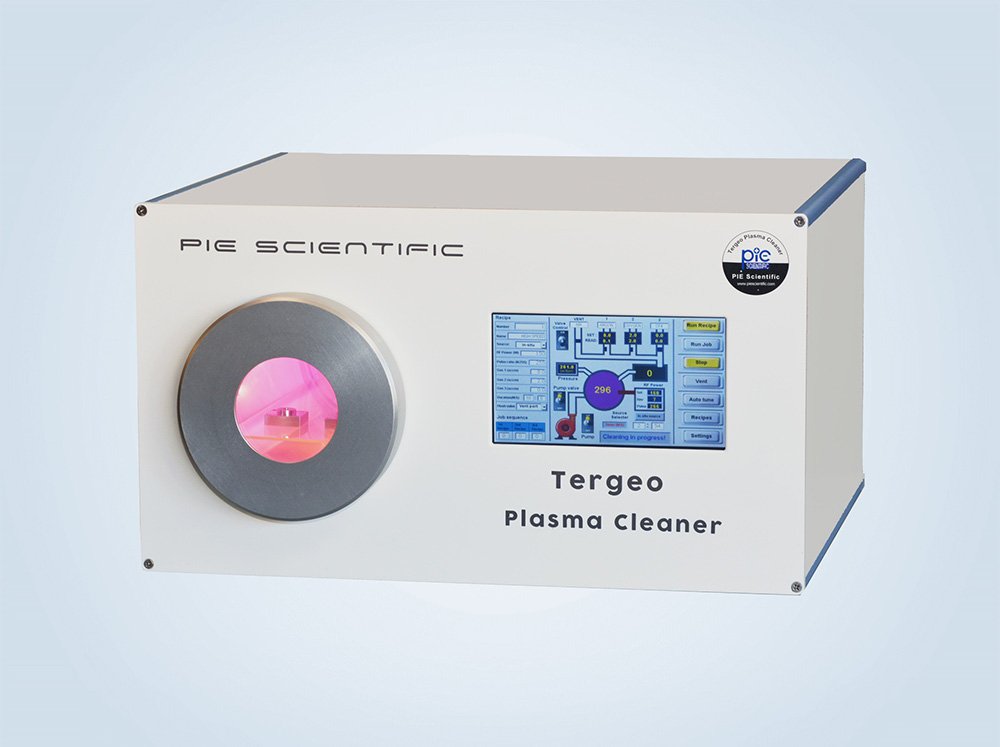
 Which Tergeo fits your lab?
What is plasma surface treatment?
Plasma surface treatment is a dry process that exposes a part to an ionized gas, the plasma, to clean its surface and change the chemistry of the top few nanometers. The treated surface has a higher surface energy, so water, adhesives, paints, inks and coatings spread over it and bond to it instead of beading up.
- Works on polymers, glass, metals and ceramics
- No solvents or primers
- Seconds to minutes per batch
How plasma surface treatment works
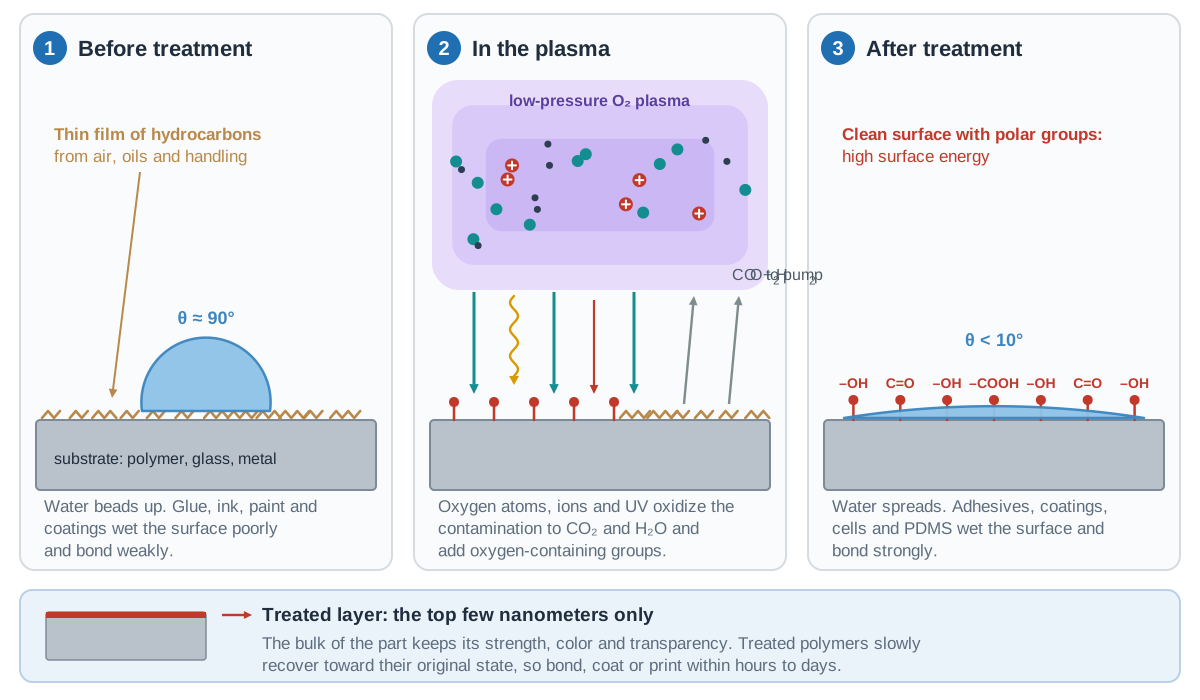
Inside a plasma, free electrons are accelerated by an electric field, usually radio-frequency (RF) power at 13.56 MHz, and split the gas molecules into reactive atoms, ions and ultraviolet light. The gas itself stays near room temperature. These species do three things at the surface.
1. Cleaning
Oxygen atoms oxidize oils, fingerprints, mold-release agents and adsorbed hydrocarbons to CO₂ and water vapor, which the vacuum pump removes. This alone often explains why a part that would not bond suddenly does.
2. Activation
Reactive atoms break C–H bonds and attach polar groups: hydroxyl, carbonyl and carboxyl with oxygen, amine-type groups with nitrogen. Polar groups raise the surface energy and give adhesives something to bond to.
3. Etching and cross-linking
Ion bombardment roughens a surface on the nanometer scale and, in argon plasma, cross-links the top polymer chains. Fluorine-containing gases do the opposite of activation and leave a water-repellent surface.
What changes after treatment
The easiest way to see plasma surface treatment is a drop of water. On an untreated polymer, contaminated glass or air-exposed aluminum the drop stands up: polycarbonate, for example, has a water contact angle of about 80–90° and PET about 70–80°. After an oxygen plasma the same drop spreads into a thin film. A fluorinated plasma can instead push the contact angle above 100°.
That change in wetting is what manufacturers and researchers use:
- Bonding and adhesion: epoxy and adhesive joints, polymer–metal bonds, and wire bonding in electronics packaging
- Microfluidics: irreversible PDMS-to-glass bonding and hydrophilic channels
- Medical devices and cell culture: catheters, implants and well plates with controlled wettability
- Coating and printing: better adhesion of paint, ink, parylene and optical coatings
- Hard-to-bond plastics: PP, PE and PTFE, PFA and FEP


Which gas to use for plasma surface treatment
The gas decides which groups end up on the surface. A vacuum system with mass-flow controllers can switch between them or mix them.
| Gas | Main effect on the surface | Typical use |
|---|---|---|
| Oxygen (O₂) | Removes organics; adds –OH, C=O and –COOH; strongly hydrophilic | Most polymers, glass, PDMS bonding, general cleaning |
| Argon (Ar) | Physical cleaning by ion bombardment; cross-links polymers; no oxidation | Metals and bond pads, oxidation-sensitive parts |
| Nitrogen (N₂) | Adds amine and amide groups; moderate hydrophilicity | Biomolecule attachment, biocompatibility |
| Air | Oxygen and nitrogen groups in one step | Low-cost activation of plastics, metals and glass |
| Water vapor (H₂O) | Dense hydroxyl layer; hydrophilicity that lasts longer | Microfluidics, cell culture, oxide surfaces |
| Hydrogen (H₂) | Removes fluorine and reduces oxides | PTFE activation, oxide-free metal surfaces |
| CF₄ and other fluorine gases | Deposits or grafts fluorinated groups; contact angle above 100° | Water-repellent surfaces, etching of oxides and nitrides |
Vacuum or atmospheric plasma surface treatment
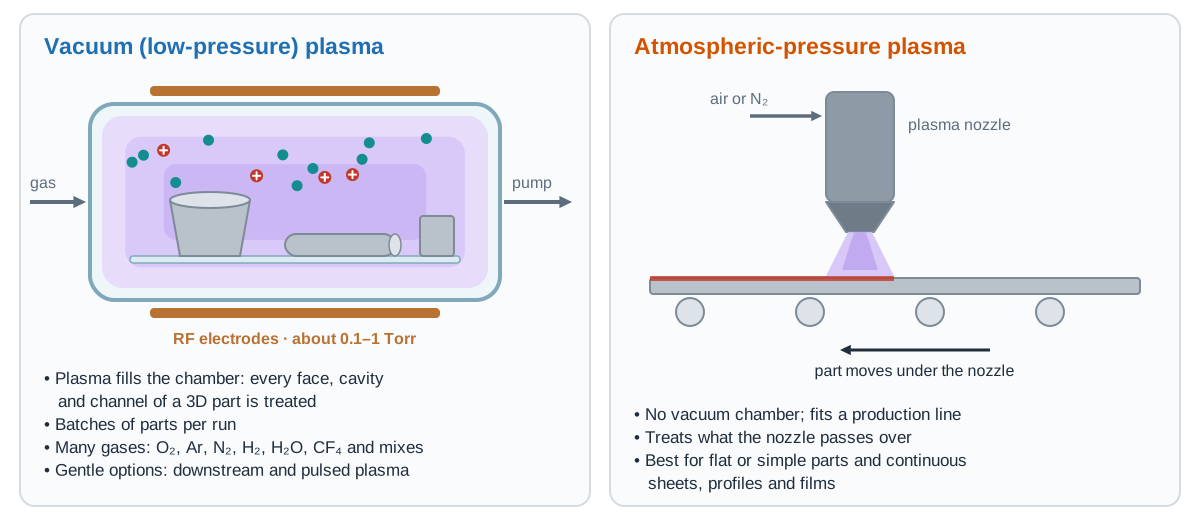
Plasma surface treatment is done either in a vacuum chamber at low pressure or with a plasma nozzle in open air. Both use the same chemistry; they differ in what kind of part they suit.
Vacuum (low-pressure) plasma
Parts sit in a chamber pumped to roughly 0.1–1 Torr. The glow fills the chamber, so the inside of a tube, the channels of a microfluidic chip and the back of a part are treated as well as the front. Gas choice is wide, and gentle modes such as downstream (remote) and pulsed plasma are available for delicate materials. This is the usual choice for laboratories, medical devices, electronics and small to medium production batches.
Atmospheric-pressure plasma
A nozzle or a corona discharge blows activated air or nitrogen onto the part, with no chamber and no pump. It fits inline on a conveyor and suits large flat parts, films, sheets and profiles that move past the nozzle. Only the area the plasma passes over is treated, and gas choice is narrower.
Plasma surface treatment questions
What is the difference between plasma cleaning and plasma surface treatment?
They happen in the same machine and often in the same run. Plasma cleaning means removing contamination. Plasma surface treatment usually means the step after that: changing the surface chemistry to make it hydrophilic, hydrophobic or easier to bond.
Does plasma surface treatment damage the part?
No, when the recipe suits the material. Only the top few nanometers change, so strength, color and transparency stay the same. Very long or high-power runs can etch or roughen soft polymers, which is why power, time and gas are set for each material.
How long does the treatment take?
Typically from a few seconds to a few minutes of plasma time, plus the time to pump the chamber down. Heavily contaminated parts need longer cleaning first.
How long does the effect last?
On polymers, the surface slowly turns back toward its original state over hours to days as polymer chains move and polar groups turn inward, and as the surface picks up new contamination. Bond, coat or print soon after treatment, store treated parts clean and sealed, or use water-vapor plasma for a more stable surface. Glass and metal oxides recover mainly through recontamination.
How do I know the treatment worked?
The quickest check is a water contact angle measurement or a dyne test. A drop that spreads into a thin film shows a high-energy surface. For bonding, a peel or shear test on treated parts is the final proof.
Read more
- Plasma surface treatment process and mechanism: gas chemistry, metals, oxides and polymers, aging, applications
- Plasma treatment for PDMS bonding
- Plasma treatment of plastics and polymers
- Epoxy, metal and composite bonding
References
- E. M. Liston, L. Martinu and M. R. Wertheimer, “Plasma surface modification of polymers for improved adhesion: a critical review,” Journal of Adhesion Science and Technology 7 (1993) 1091–1127. doi:10.1163/156856193X00600
- F. D. Egitto, “Plasma etching and modification of organic polymers,” Pure and Applied Chemistry 62 (1990) 1699–1708. doi:10.1351/pac199062091699
- M. A. Lieberman and A. J. Lichtenberg, Principles of Plasma Discharges and Materials Processing, 2nd ed., Wiley, 2005.
Tergeo plasma surface treatment systems
Tergeo tabletop plasma systems treat parts in a quartz chamber with up to three mass-flow-controlled gas lines, 13.56 MHz RF power, direct (and on most models downstream) modes and pulsed plasma. Chambers range from Ø110 mm (Tergeo) to Ø230 × 340 mm (Tergeo-Pro).
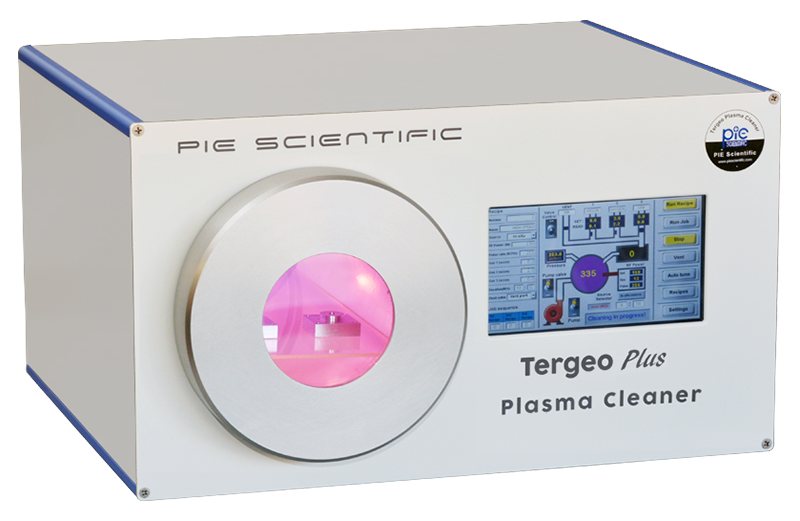
Not sure which plasma cleaner fits your process?
Tell us your samples, size and process gas. Our engineers reply within one to two business days with a recommendation and a quote.