
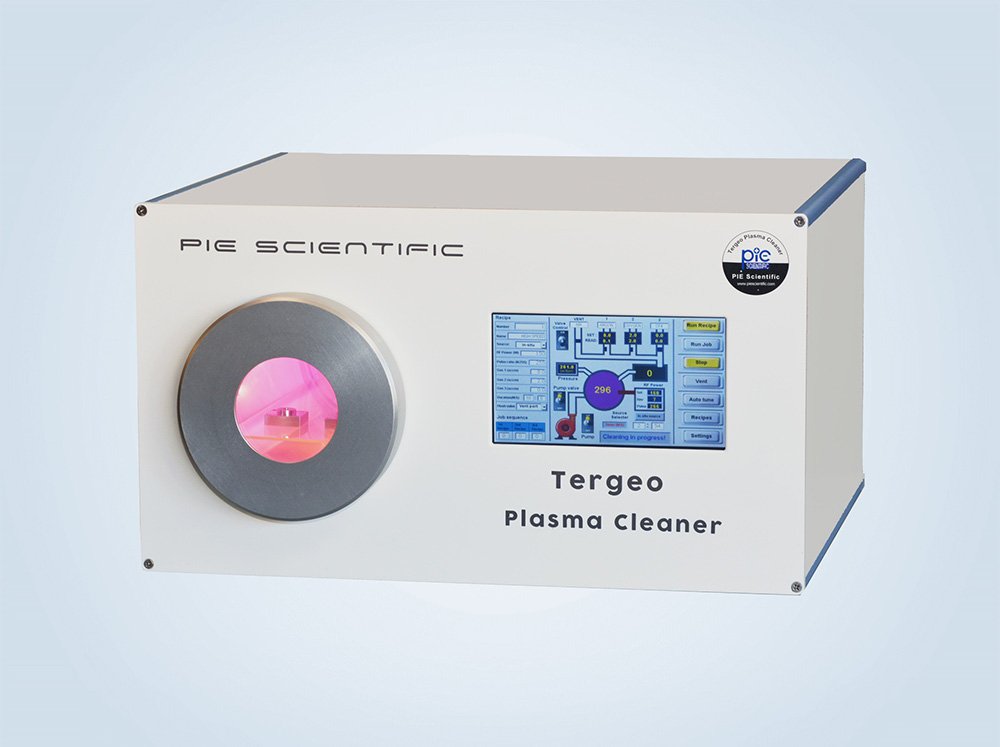
 Which Tergeo fits your lab?
Oxygen plasma cleaning, etching and surface treatment
Oxygen plasma turns organic material — contamination, photoresist, polymer films, filters — into CO, CO₂ and water vapor that the vacuum pump carries away, and it leaves metal, glass and polymer surfaces clean and hydrophilic. It is the most widely used process gas in a laboratory plasma cleaner. Below are results measured in Tergeo oxygen plasma cleaners, with the recipes used.
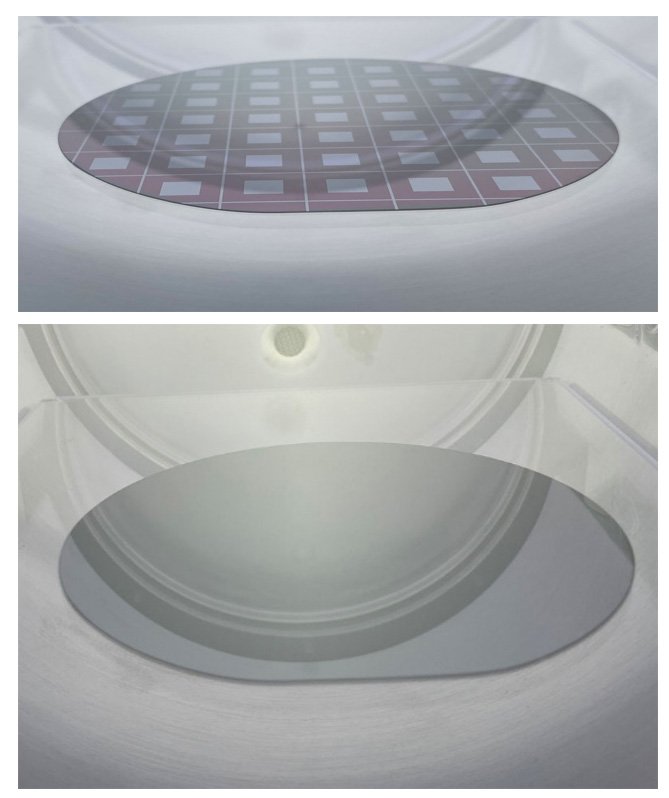
- Photoresist > 1 µm/min (500 W)
- Parylene ≈ 230 nm/min (150 W)
- Filters ashed a few °C above room temperature
What oxygen plasma does to a surface
At a few hundred mTorr, 13.56 MHz RF power splits O₂ into atomic oxygen, ions and UV light. The atomic oxygen does most of the work.
Cleaning and ashing
Hydrocarbons and other organics are oxidized to volatile CO, CO₂ and H₂O. Nanometer-thin contamination is gone in seconds to minutes; thick resist, polymer or carbon layers are removed layer by layer (ashing). Inorganic material — metals, oxides, minerals — stays behind.
Surface activation
Oxygen plasma adds hydroxyl and other polar groups to the top few nanometers. Water contact angle drops, surface energy rises, and glues, coatings, inks and bonded PDMS stick far better. The bulk material is unchanged.
Etching
Polymers such as parylene, polyimide and SU-8, and carbon materials such as graphene, are etched at a rate set by RF power, pressure and mode — from fast direct-mode stripping of polymers to slow, pulsed treatment that removes a single graphene layer.
Oxygen plasma results in Tergeo systems
Each row comes from a test in our lab or with a customer's samples. Follow the link for the full method, photos and data.
| Process | Sample | Recipe | Result |
|---|---|---|---|
| Photoresist ashing | Photoresist on silicon wafers | O₂, Tergeo-Plus with 500 W option | More than 1 µm/min, depending on resist type and bake |
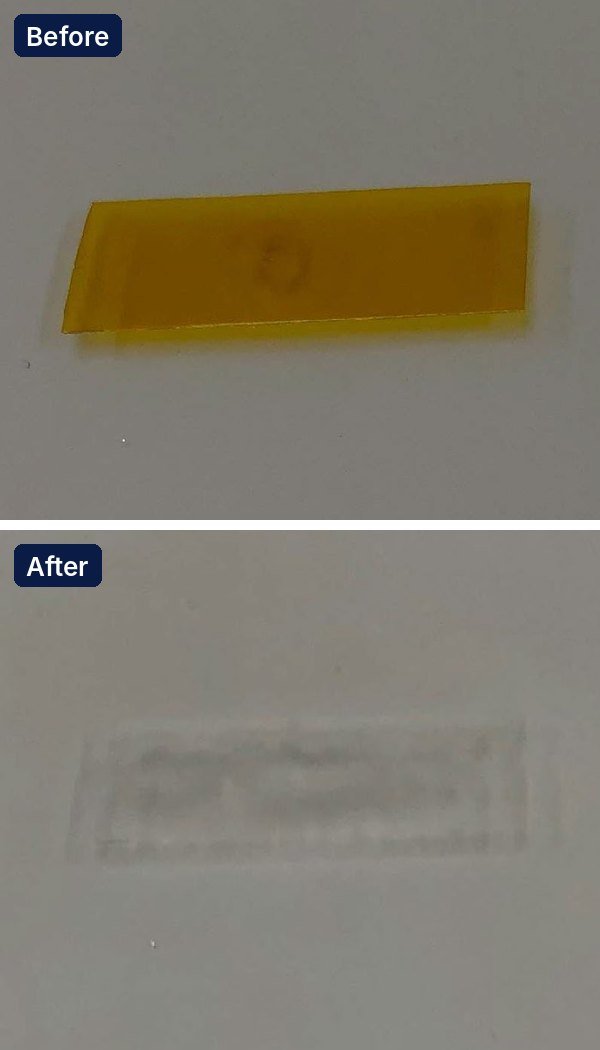
| Parylene removal | 4.67 µm parylene C on glass; parylene-coated aluminum part | 150 W, 5 sccm O₂, ≈ 90 mTorr, direct mode | ≈ 230 nm/min; aluminum contact resistance back to 0.3 Ω after 20 min per side |
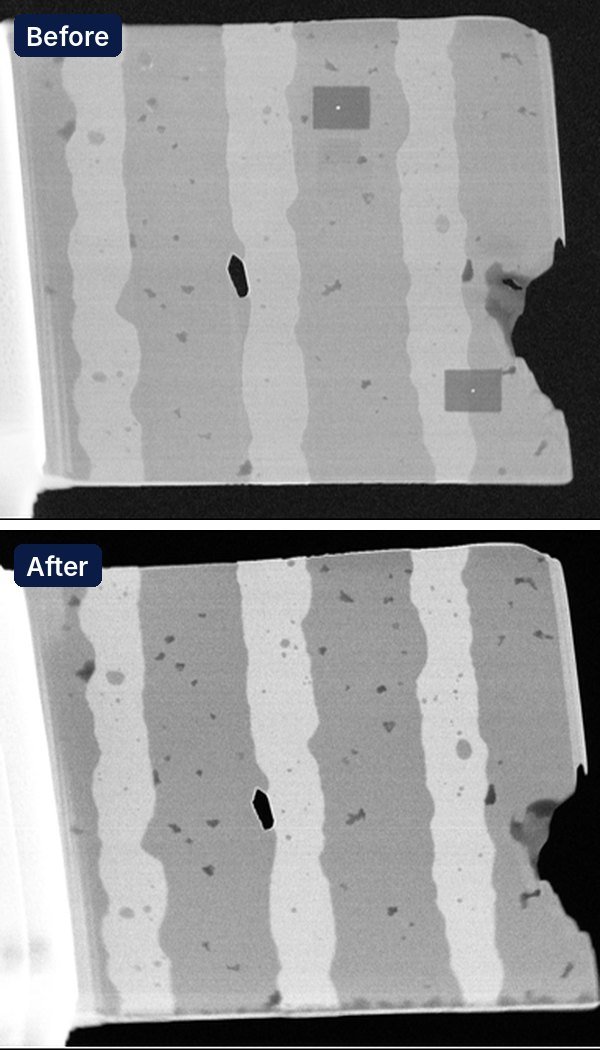
| Polyimide ashing | 25 µm polyimide film on silicone adhesive | Ar + O₂ | Polyimide layer largely removed in ≈ 3 h |
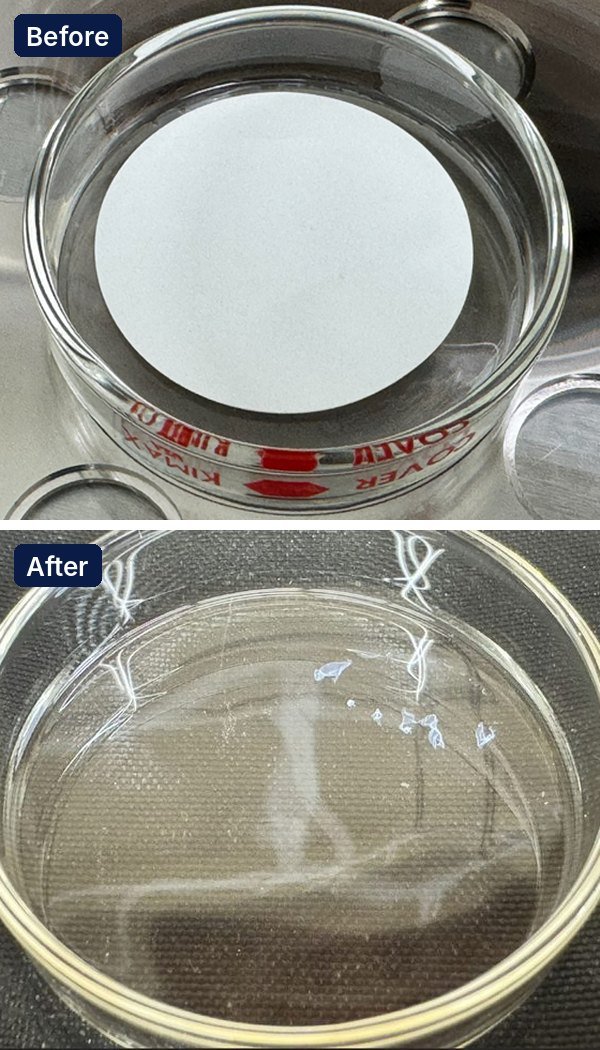
| Low-temperature filter ashing | 47 mm cellulose acetate membrane filter | 30 W or 15 W O₂ | End point at 15.5 min (30 W) or 55.5 min (15 W); dish only 6–8 °C above room temperature |
| Coal and charcoal ashing | Charcoal and coal powders | 75 W, 10 sccm O₂ | Charcoal end point after ≈ 3.5 h; mineral ash left for analysis |
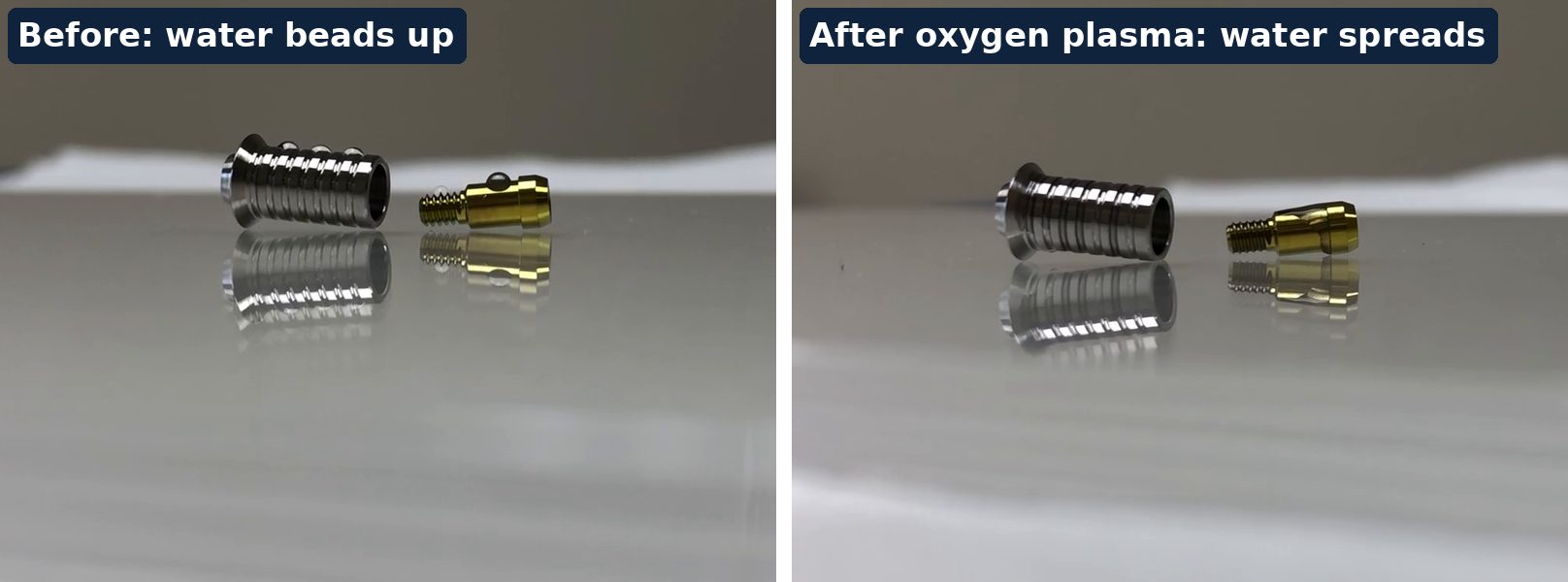
| Implant activation | Titanium dental implant and abutment | 75 W O₂ | Water beads before; spreads across the implant and abutment after |
| Decontamination | Titanium samples | Step 1: 150 W, 5 sccm O₂, 2 min · Step 2: 75 W, 7 sccm O₂ + 10 sccm water vapor, 2 min | No bacterial growth on the plated samples (laboratory demonstration, not a validated sterilization process) |
Choosing an oxygen plasma cleaner
All Tergeo models run oxygen, room air and the other process gases with the same touchscreen recipes and plasma intensity sensor. Choose by sample size and throughput.
Tergeo
Chips, slides, PDMS, filters and small parts in a Ø110 mm chamber; 75 or 150 W.
View Tergeo →Tergeo-Plus
One 6″ wafer or a 4″ wafer boat; up to 500 W for photoresist ashing and descum.
View Tergeo-Plus →Tergeo-Pro
8″ wafers, wafer-boat batches and larger parts in a Ø230 × 340 mm chamber.
View Tergeo-Pro →Tergeo-EM
TEM/SEM holders, samples and cryo-EM grids, with gentle pulsed plasma.
View Tergeo-EM →Getting the oxygen plasma recipe right
Direct, downstream or pulsed
Direct mode puts the sample in the plasma for the fastest ashing and etching. Downstream mode lets only radicals reach the sample, avoiding ion bombardment on fragile or ESD-sensitive parts. Pulsed plasma lowers the average dose further for 2D materials and thin carbon films.
Know when it is done
While organic material burns off, the plasma emission changes. The built-in plasma intensity sensor shows this in real time, so ashing and stripping can be stopped at the end point instead of at a guessed time.
Use an oxygen-safe pump
Pure oxygen must not go through a pump filled with hydrocarbon oil. Use a dry scroll pump rated for oxygen service or a rotary pump filled with inert PFPE oil. We can supply either with the system.
Oxygen is not always the best choice. For oxidation-sensitive metals such as copper or silver, argon or hydrogen plasma cleans without growing an oxide. For PDMS bonding, adding water vapor gives a denser, longer-lasting layer of OH groups — see PDMS plasma bonding.
Oxygen plasma questions
What is the difference between oxygen plasma cleaning and ashing?
The chemistry is the same. Cleaning removes nanometer-thin contamination in seconds to minutes; ashing removes thick organic material — photoresist, polymer films, filters, coal — and can take minutes to hours.
Will oxygen plasma oxidize my metal sample?
Noble metals and most oxides are not affected. Copper, silver and other reactive metals can grow a thin oxide; use argon or hydrogen plasma, or follow the oxygen step with a short hydrogen step.
Does the sample get hot?
At low power the sample stays near room temperature — a dish holding a filter rose only 6–8 °C at 15–30 W. At high power and long times the chamber and sample warm up, so heat-sensitive samples are run at lower power or with pulsed plasma.
Can I use room air instead of a pure oxygen cylinder?
For many cleaning and activation jobs, yes: room air contains about 21% oxygen and works well for grids, implants and PDMS. Pure oxygen is faster for ashing and photoresist stripping.
Not sure which plasma cleaner fits your process?
Tell us your samples, size and process gas. Our engineers reply within one to two business days with a recommendation and a quote.