
 Which Tergeo fits your lab?
Hydrocarbon contamination control for e-beam inspection, review and CD-SEM
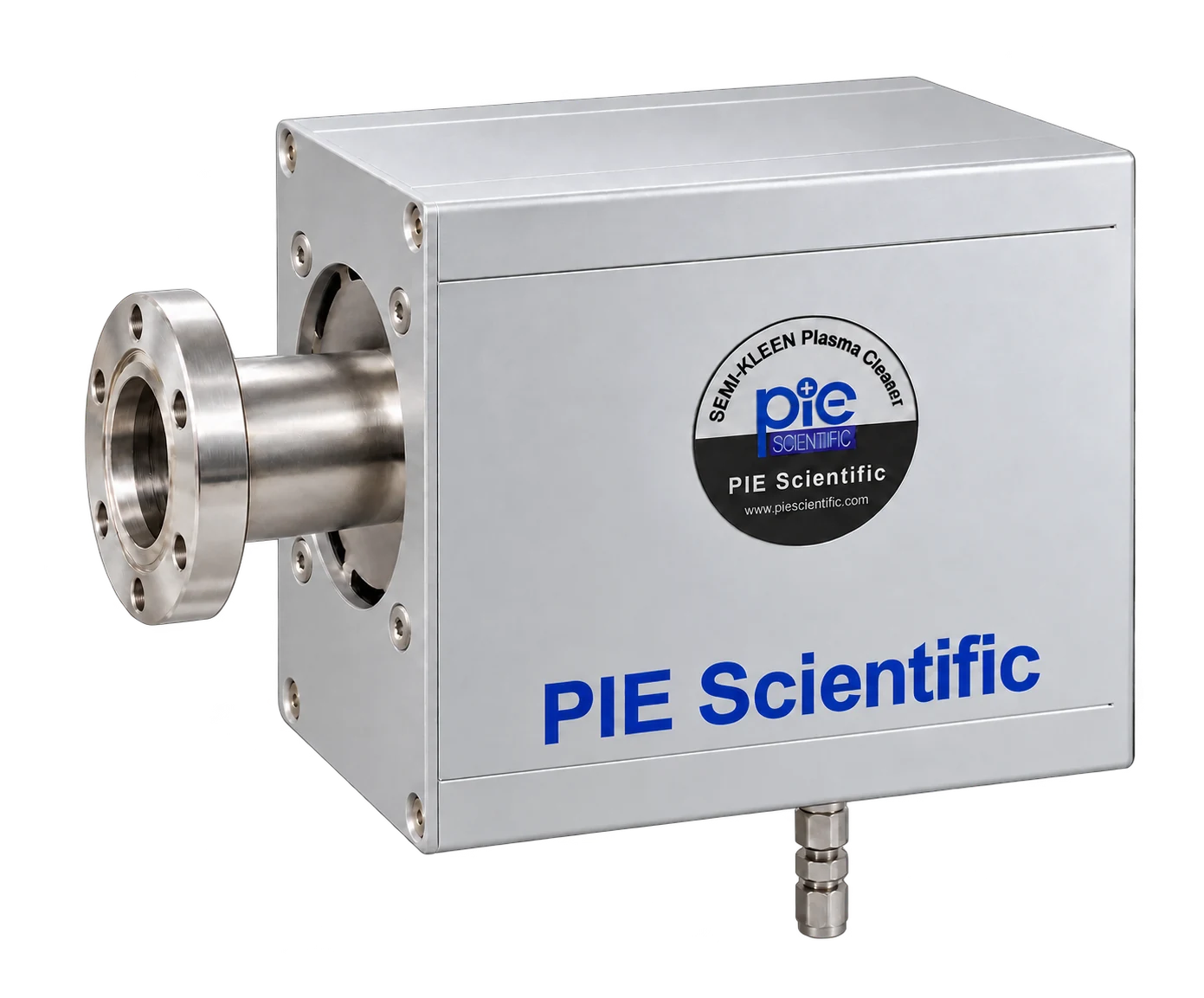
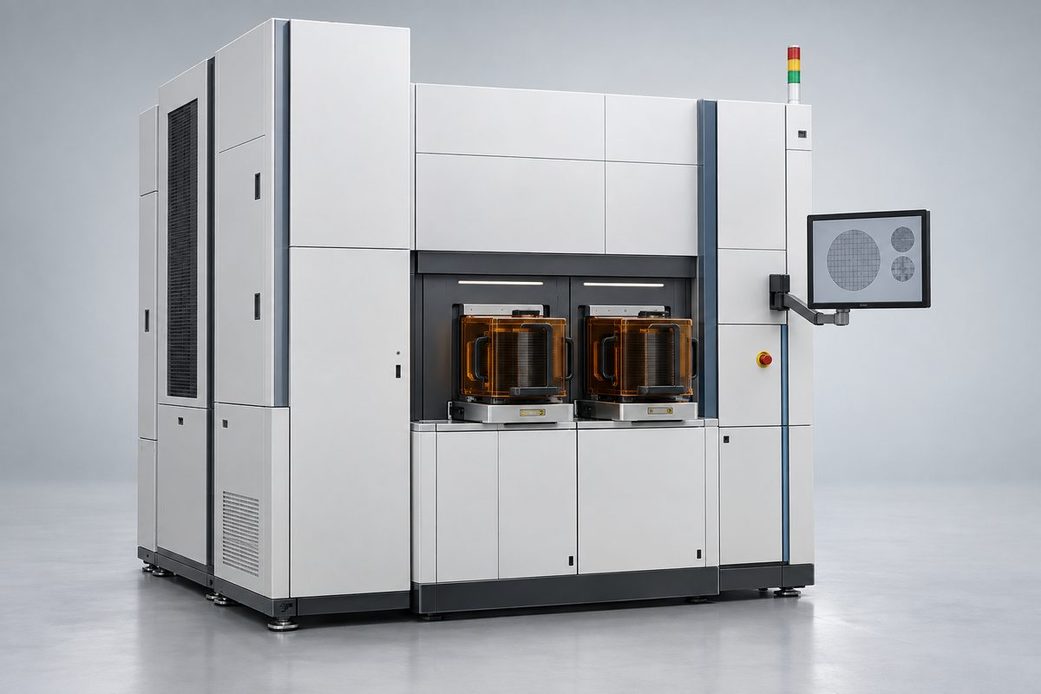
SEMI-KLEEN in-situ downstream plasma cleaners remove hydrocarbon contamination from the vacuum chambers of e-beam review (EBR), e-beam inspection (EBI) and CD-SEM tools — fully automatic, without venting, and run from the tool's own controller.
- Hydrocarbons 20–60× lower (RGA)
- Runs below 0.1 mTorr
- Low-particle design
Why hydrocarbons matter in e-beam metrology and inspection
Every electron beam cracks residual hydrocarbon molecules into a thin carbon film wherever it lands — on the wafer, on apertures and on the column optics. In a CD-SEM this grows the measured lines and causes drift between repeated measurements; in inspection and review tools it shows up as scan marks, charging and lower image contrast.
Hydrocarbons come in with every wafer and every maintenance vent: photoresist and wafer outgassing, lubricants, elastomer seals and handling. Semiconductor capital equipment has much larger chambers than an analytical SEM, so the contamination has more surface to sit on and more time to accumulate.
A downstream plasma sends oxygen (or hydrogen) radicals through the chamber. They turn the hydrocarbons into CO, CO₂ and H₂O, which the turbopump removes — before the beam can turn them into carbon.
Hydrocarbon cleaning measured by RGA
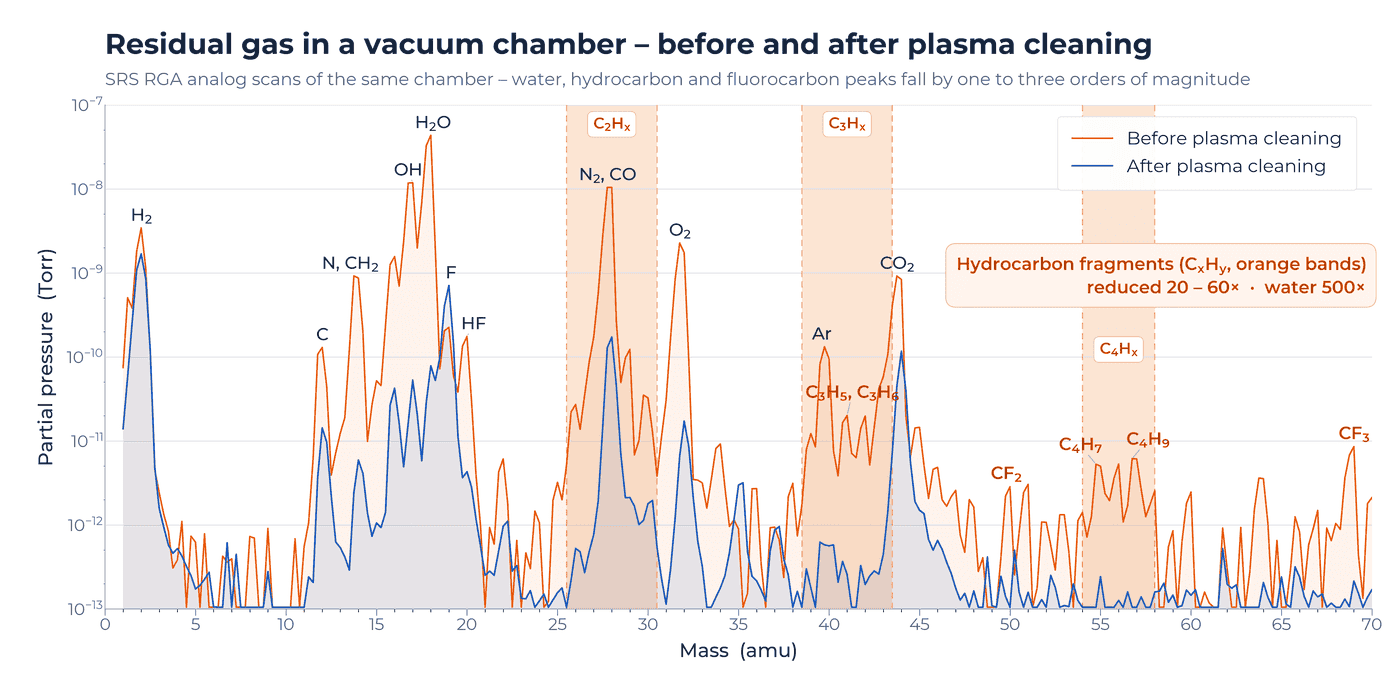
Residual gas analyzer (RGA) analog scans of the same vacuum chamber before and after SEMI-KLEEN plasma cleaning. The partial-pressure axis is logarithmic: one grid step is a factor of ten.
Hydrocarbons 20–60× lower
The hydrocarbon fragment groups — C₂Hₓ (mass 25–30), C₃Hₓ (mass 39–43, including C₃H₅ and C₃H₇) and C₄Hₓ (mass 55–57, C₄H₇ and C₄H₉) — drop 20–60×.
Water about 500× lower
The H₂O and OH peaks at mass 17–18 fall by about 500× after plasma cleaning and bake-out, so the chamber reaches base pressure sooner.
Fluorocarbons removed too
The CF₂ and CF₃ fragment peaks (mass 50 and 69) disappear into the background after cleaning.
Why SEMI-KLEEN fits EBR, EBI and CD-SEM tools
Many features of the SEMI-KLEEN plasma cleaner are tailored to the requirements of the semiconductor capital equipment industry. Its fully automatic design supports seamless integration into everyday tool operation.
Operates below 0.1 mTorr
High-efficiency discharge technology runs reliably at pressures below 0.1 mTorr — one to two orders of magnitude lower than conventional remote plasma cleaners. The turbopump keeps running at lower load during cleaning, which helps pump lifetime.
Low-particle source design
A proprietary low-particle plasma source design meets the particles-per-wafer-pass (PWP) requirements of leading chipmakers.
No manual adjustment
Automatic impedance matching and automatic gas delivery give consistent, repeatable cleaning for every recipe without manual tuning.
EMI reduction
EMI suppression keeps RF noise out of the electron column and tool electronics, wherever the controller is installed in the electronics rack.
How in-situ plasma cleaning fits into the tool
Mount
The source mounts on a spare CF or KF port of the main chamber or load-lock. Custom flanges and cable lengths are available.
Integrate
The 3U half-width rack-mount controller sits in the tool's electronics rack; interlocks connect to the host.
Run
The host controller starts, stops and monitors recipes over RS-232 / RS-485 — during idle time or after a maintenance vent.
Pump
Cleaning runs under vacuum with the turbopump on; no venting, no chamber opening.
SEMI-KLEEN series downstream plasma cleaners
SEMI-KLEEN Quartz
O₂, H₂, air, Ar, He and N₂ plasma for e-beam, EUV and X-ray tools.
Details →
SEMI-KLEEN Sapphire
Sapphire tube for hydrogen and fluorine-rich chemistries.
Details →
SEMI-KLEEN UHV
Glass-to-metal brazed source for UHV and XHV chambers.
Details →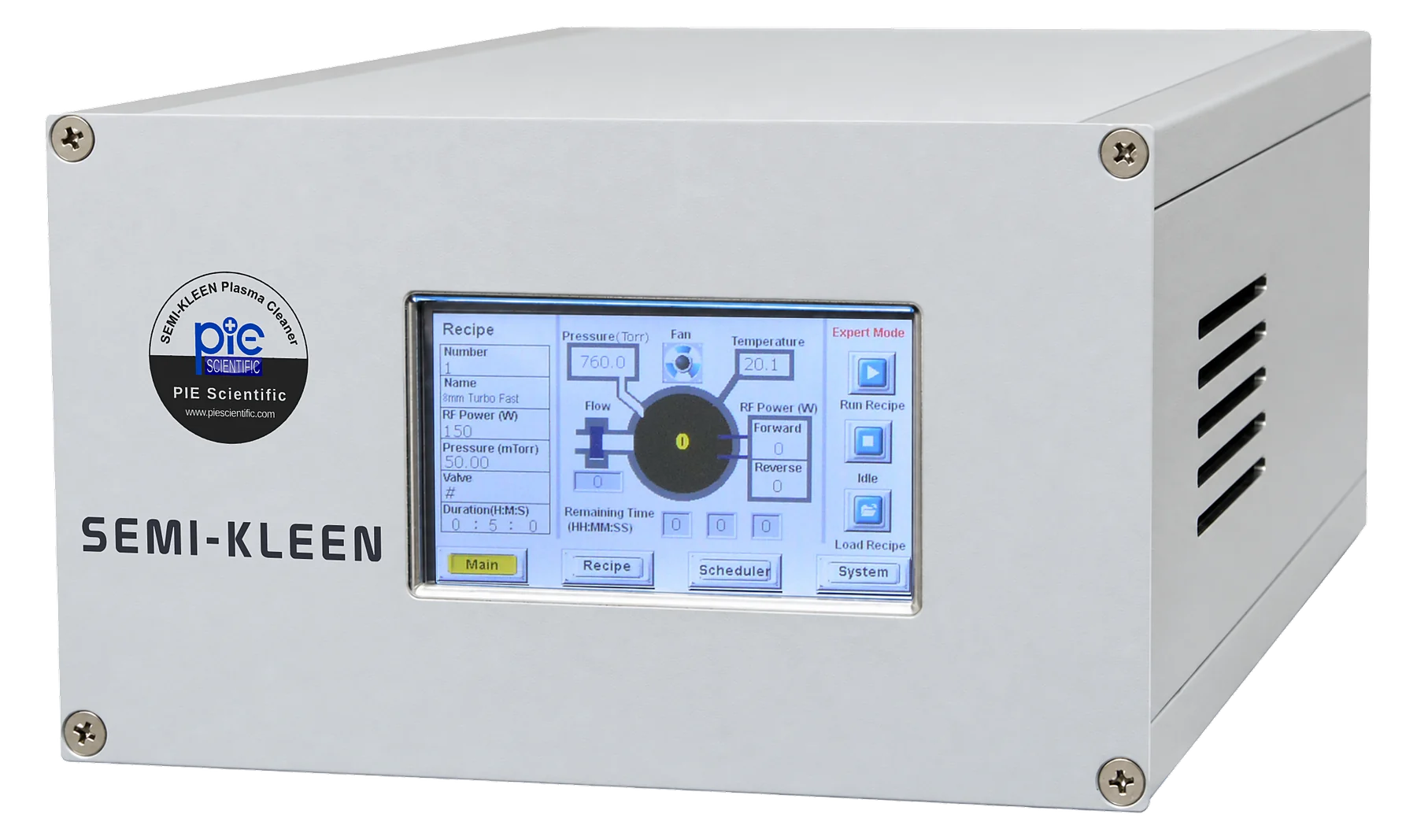
150 W controller
Rack-mount controller with remote recipe control for OEM integration.
Details →Related applications: e-beam & EUV tools · EUV lithography · analytical SEM & FIB · UHV chambers
Hydrocarbon contamination in e-beam tools
What causes hydrocarbon contamination in a CD-SEM or e-beam inspection tool?
Organic molecules from wafers and photoresist, lubricants, elastomer seals, handling and maintenance vents adsorb on chamber surfaces. The electron beam cracks them into a carbon film on the wafer, apertures and optics, causing CD growth, drift, scan marks and charging.
How does downstream plasma remove hydrocarbons?
The plasma is generated in the SEMI-KLEEN source, and only neutral radicals flow into the chamber. Oxygen radicals oxidize hydrocarbons to CO, CO₂ and H₂O, which are pumped away. No ions reach the wafer or column, so there is no sputtering.
Can the turbopump keep running during plasma cleaning?
Yes. SEMI-KLEEN operates below 0.1 mTorr, so cleaning runs at the tool's normal high-vacuum pumping with the turbopump on, and at lower pump load than higher-pressure plasma cleaners.
Oxygen or hydrogen plasma?
Oxygen (or air) radicals remove hydrocarbons fastest. Hydrogen is used where surfaces must not oxidize, for example some EUV optics — the SEMI-KLEEN Sapphire source is preferred for hydrogen plasma. See hydrogen plasma cleaning.
Does plasma cleaning add particles?
The source uses a proprietary low-particle design that meets the particles-per-wafer-pass requirements of leading chipmakers.
Not sure which plasma cleaner fits your process?
Tell us your samples, size and process gas. Our engineers reply within one to two business days with a recommendation and a quote.