
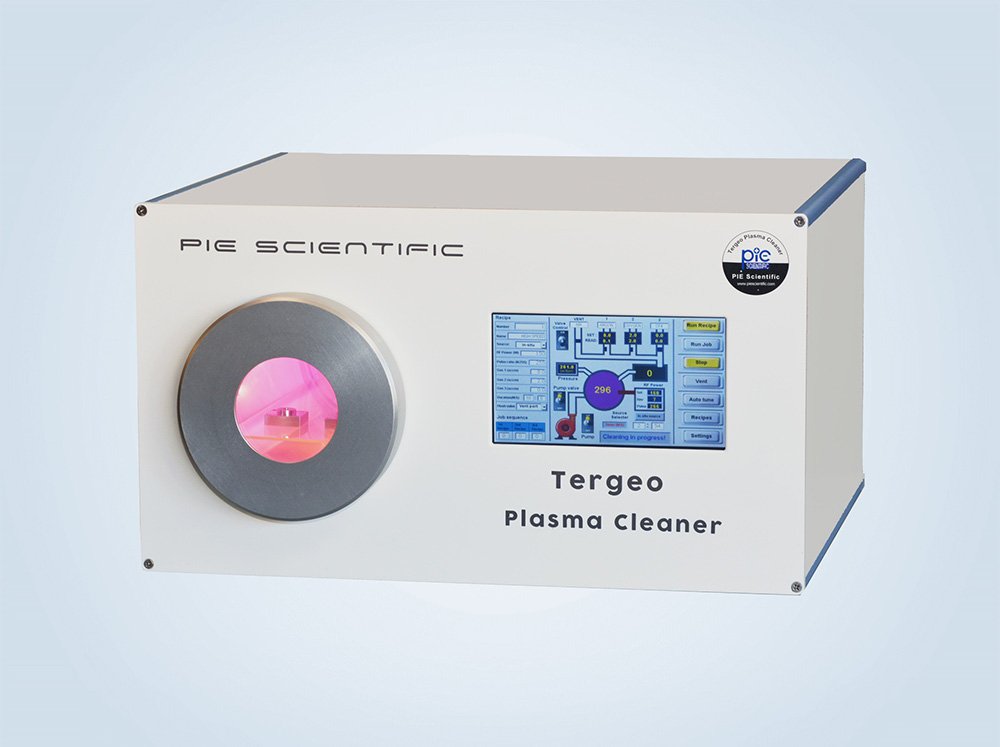
 Which Tergeo fits your lab?
Improve Bonding and Adhesion on PTFE, PFA and FEP with Plasma Treatment
Fluoropolymers such as PTFE (Teflon), PFA, and FEP are widely used for their chemical resistance and non-stick properties. However, their low surface energy and inert surface chemistry make adhesive bonding and coating applications difficult. Plasma surface treatment provides an effective solution by modifying the surface chemistry and increasing surface energy to enable strong, reliable adhesion.
How Plasma Treatment Works
Plasma modifies fluoropolymer surfaces through:
- Ion Bombardment: Breaks chemical bonds, creating reactive surface sites.
- UV/VUV Radiation: Facilitates radical formation and bond cleavage.
- Defluorination: Removes fluorine atoms, creating active carbon sites.
- Radical Formation and Functionalization: Introduces reactive functional groups such as hydroxyl, carbonyl, or amino groups, significantly boosting surface polarity and compatibility with adhesives and coatings.
These changes significantly improve surface wettability and chemical reactivity, allowing adhesives, coatings, and paints to form strong chemical bonds with the treated surface.


Advantages of Plasma Treatment
Compared to traditional chemical etching using sodium solutions, plasma offers safer, cleaner, and environmentally friendly processes without generating toxic waste. Chemical etching, while effective, often leads to deeper structural changes and potential environmental hazards. In contrast, corona discharge, an atmospheric plasma method, provides limited effectiveness due to its lower energy and surface penetration capabilities. Vacuum plasma treatment, therefore, stands out as an optimal choice offering precise, controlled, and uniform surface modifications..
Plasma Gases and Their Effects
Different plasma gases uniquely influence fluoropolymer characteristics:
- Oxygen (O₂) Plasma: Enhances hydrophilicity through polar oxygen-containing groups.
- Ammonia (NH₃) Plasma: Efficiently introduces amine groups, ideal for strong epoxy bonding.
- Hydrogen (H₂) Plasma: Removes fluorine atoms efficiently, setting the stage for subsequent functionalization.
- Argon (Ar) Plasma: Physically roughens surfaces, increasing reactive site density for further chemical modification.


Industrial Applications and Success Stories
Plasma treatment significantly improves adhesive bonding, coating durability, and surface functionality across industries:
- Electronics: Improves copper adhesion to fluoropolymer PCBs.
- Medical Devices: Enhances bond strength of catheter tubing to silicone connectors, ensuring device reliability.
- Aerospace: Strengthens adhesion of protective coatings under demanding environmental conditions.
How It Improves Bonding:
Plasma treatment increases surface energy by introducing polar groups, improving wetting and adhesive compatibility. Gases like oxygen, ammonia, and hydrogen are especially effective for activating fluoropolymer surfaces. In contrast, specific plasma conditions can also decrease surface energy and create superhydrophobic surfaces for anti-stick or water-repellent applications.
Summary:
Plasma treatment emerges as a robust, efficient, and environmentally friendly technique for enhancing fluorocarbon polymer (PTFE, FEP, PFA, etc.) adhesion capabilities. Properly optimized plasma processes allow manufacturers to effectively address bonding challenges, expanding fluoropolymer application potential across critical industrial sectors.