
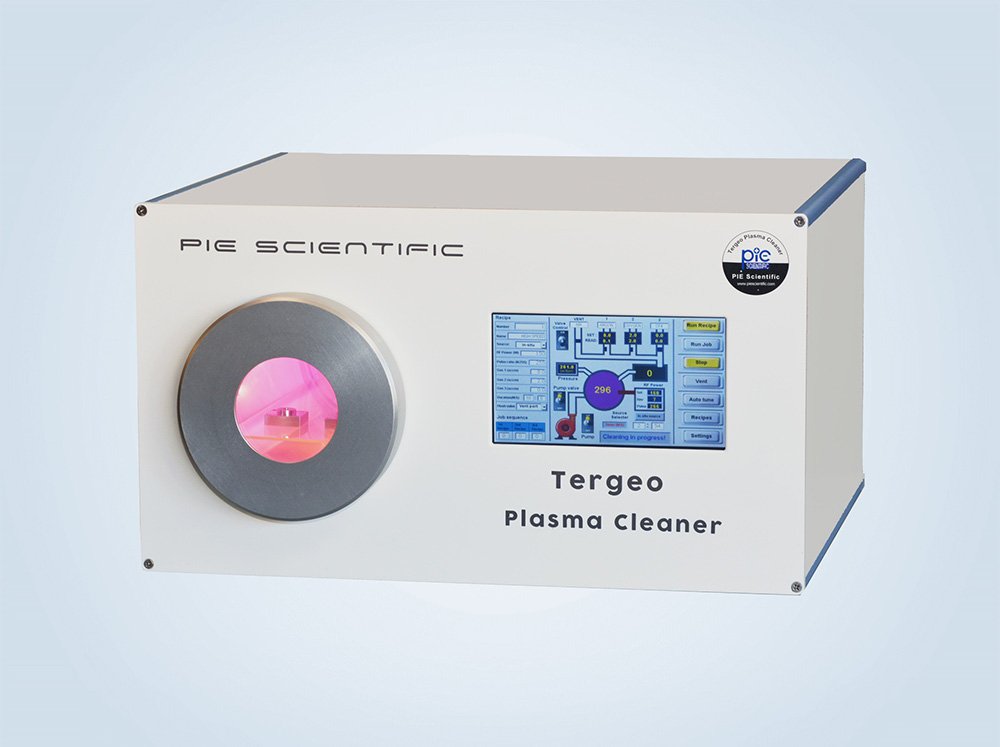
 Which Tergeo fits your lab?
Plasma cleaning and sharpening of AFM tips
The tip decides what an atomic force microscope can resolve. Low-pressure plasma removes organic contamination from AFM probes, makes silicon and silicon-nitride tips hydrophilic, activates them for functionalization — and, in high-speed AFM labs worldwide, sharpens electron-beam-deposited carbon tips to a 1–2 nm apex in about a minute.
- Tip apex ≈1–2 nm after Ar plasma
- 20 W, 1–1.5 min, argon
- Used in 18 published AFM studies
Three things plasma does for AFM probes
Sharpen carbon tips
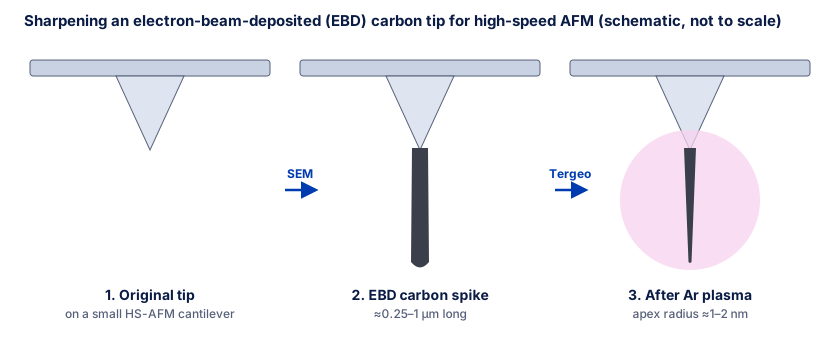
Argon plasma etches the amorphous carbon spike grown on a probe by electron-beam deposition (EBD), thinning its end to an apex radius of about 1–2 nm. This is the standard way high-speed AFM (HS-AFM) labs make tips sharp enough to resolve single proteins.
Remove contamination
New cantilevers often arrive coated with organic contamination, such as silicone from the packaging gel. That film changes adhesion and friction forces and can transfer to the sample. A short oxygen or air plasma removes it without solvents or touching the tip.
Hydrophilic, reactive surfaces
Plasma leaves silicon and silicon-nitride surfaces covered in hydroxyl groups. The tip wets easily in liquid imaging, and silane (e.g. APTES) or other coupling chemistry attaches reliably when making functionalized probes.
Sharpening EBD carbon tips for high-speed AFM
HS-AFM films proteins at video rate with small cantilevers whose built-in tip is too blunt for molecular resolution. Labs therefore grow an amorphous carbon spike on the tip in an SEM (typically from ferrocene or residual hydrocarbons) and sharpen it in a Tergeo plasma cleaner with argon plasma.
| Published conditions | Value |
|---|---|
| Gas | Argon |
| Mode | Direct (immersion) plasma |
| RF power | 15–20 W |
| Gas flow / pressure | 10 sccm, or ≈180 mTorr |
| Time | 30 s – 1.5 min |
| Result | Apex radius ≈1 nm (several studies); 4 nm → 1.5–2 nm (Ye et al., 2024) |
The most-cited recipe: direct mode, Ar 10 sccm, 20 W, 1.5 min.
Why it works
In direct mode the probe sits in the argon glow, and ions remove the amorphous carbon atom by atom. The thin end of the spike loses material from all sides, so the apex gets sharper while the spike stays strong enough to scan. Argon is chemically inert, so the silicon-nitride cantilever and its reflective coating are not oxidized.
Because etching is fast at this scale, power and time matter. The Tergeo's 1 W power steps, recipe memory and real-time plasma intensity reading let a lab repeat the same sharpening on every cantilever — and a gold-coated tip can still be functionalized afterwards, as shown for molecular-recognition HS-AFM (Puppulin et al., 2021).
Cleaning AFM probes and making them hydrophilic
Organic and inorganic contamination on as-received AFM cantilevers is well documented (Lo et al., 1999). It shows up as unstable adhesion in force spectroscopy, drifting friction in lateral force microscopy, and residues transferred to clean samples.
A gentle oxygen, air or water-vapor plasma removes this layer and leaves a hydrophilic, hydroxyl-rich surface on silicon and silicon-nitride probes. The same step activates cantilever surfaces before covalent functionalization — for example, microcantilever sensor arrays were O₂-plasma activated in a Tergeo-Plus before attaching their sensing chemistry (Cooper et al., Biosens. Bioelectron. 2022 — MEMS sensor cantilevers rather than AFM imaging tips).
Plasma-cleaned surfaces slowly pick up airborne hydrocarbons again, so clean or activate probes shortly before use.
| Probe type | Suggested starting point |
|---|---|
| Bare Si or Si₃N₄ — cleaning, hydrophilic | O₂, air or H₂O vapor; low power, downstream or pulsed; seconds to a minute |
| Before silane / APTES functionalization | O₂ or H₂O vapor plasma, then functionalize promptly |
| EBD carbon tip sharpening | Ar, direct mode, 20 W, 10 sccm, 30–90 s |
| Carbon, diamond-like or polymer-coated tips — cleaning only | Avoid oxygen; use argon or downstream mode at very low power |
| Metal-coated (Au, Pt) and magnetic tips | Short, gentle plasma; test first — oxygen can oxidize some coatings |
Starting points only. Oxygen plasma also etches carbon, so never use it on a carbon tip you want to keep sharp.
Published studies that sharpened AFM tips in a Tergeo plasma cleaner
Each study below states in its methods that the electron-beam-deposited carbon tip was sharpened with argon plasma in a Tergeo plasma system (sometimes listed as "PIC Scientific"). The plasma step is part of the methods — most papers are about the proteins imaged. Most come from high-speed AFM groups at Kanazawa University (WPI-NanoLSI) and their collaborators.
Background reference: Lo, Y.-S. et al., Organic and inorganic contamination on commercial AFM cantilevers, Langmuir 15, 6522 (1999).
AFM tip plasma cleaning: common questions
Can I plasma clean an AFM tip?
Yes. A short, low-power oxygen, air or water-vapor plasma removes organic contamination from silicon and silicon-nitride tips and makes them hydrophilic. Use argon or a very gentle downstream setting instead for carbon, diamond-like or polymer-coated tips, which oxygen would etch.
What recipe do labs use to sharpen EBD carbon tips?
The most common published recipe is argon plasma in direct mode, 10 sccm, 20 W for 1.5 minutes in a Tergeo plasma cleaner. Other groups report 15 W for 1 minute or about 180 mTorr at 20 W for 30–90 seconds. Apex radii of about 1–2 nm are reported.
Will plasma damage the cantilever or its reflective coating?
Argon does not oxidize the silicon-nitride cantilever or a gold back-side coating, and the published sharpening steps last only seconds to about a minute. Test oxygen-containing recipes on a spare probe first if your tip has a metal or magnetic coating.
How long does a plasma-cleaned tip stay clean?
Airborne hydrocarbons start to re-adsorb within hours. Clean or activate probes shortly before imaging or functionalization, and store them in a clean, closed box.
Related: Tergeo plasma cleaner · Argon plasma cleaning · TEM, SEM & FIB sample cleaning · Fragile TEM carbon grids
Not sure which plasma cleaner fits your process?
Tell us your samples, size and process gas. Our engineers reply within one to two business days with a recommendation and a quote.