
 Which Tergeo fits your lab?
Low-temperature oxygen plasma ashing for asbestos and crystalline silica analysis
Low-temperature plasma ashing (LTA) removes the organic part of a sample, such as a membrane filter, a PVC filter, an organic binder, tissue or coal, with oxygen atoms made in an RF plasma. The organic matter leaves as CO₂ and water. Asbestos fibers, quartz and other minerals stay behind unchanged, because the sample stays near room temperature instead of the 450–815 °C of a muffle furnace.
- Dish only 6–8 °C above room temperature at 15–30 W
- 47 mm filter ashed in about 20 min
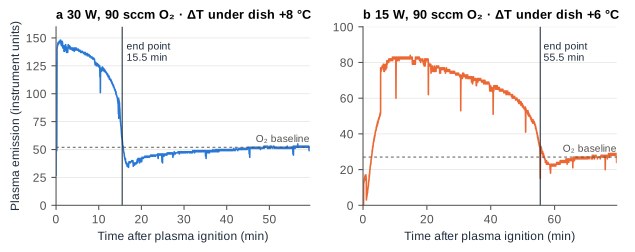
- End point read from the plasma emission
Why the ashing temperature decides the result
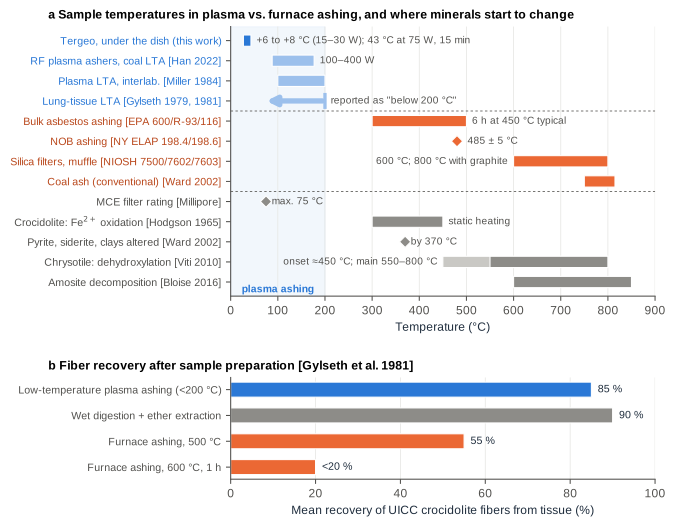
A plasma asher and a muffle furnace both remove organic matter. The difference is heat. In an RF plasma the energetic electrons break molecular oxygen into reactive atomic oxygen, while the gas stays near room temperature. Oxygen atoms do the work chemically, so the sample is warmed only by the reaction itself. A furnace has to heat the whole sample to 450–600 °C, or 750–815 °C for coal ash, and several of the analytes change in that range:
- MCE filters are rated to 75 °C. A filter that softens or curls moves the fibers it holds.
- Chrysotile starts to form a talc-like phase at the fiber edges from about 450 °C. The EPA bulk method caps furnace ashing at 500 °C for this reason.
- Crocidolite starts to lose hydrogen and oxidize at 300–450 °C, and heating changes the refractive index that PLM relies on.
- Quartz reacts with calcite in a furnace, which lowers the silica result in limestone-dusted coal mines.
In one study, crocidolite added to tissue was recovered at 85 % after plasma ashing, 55 % after furnace ashing at 500 °C and less than 20 % after 1 h at 600 °C.
Where plasma ashing appears in standard methods
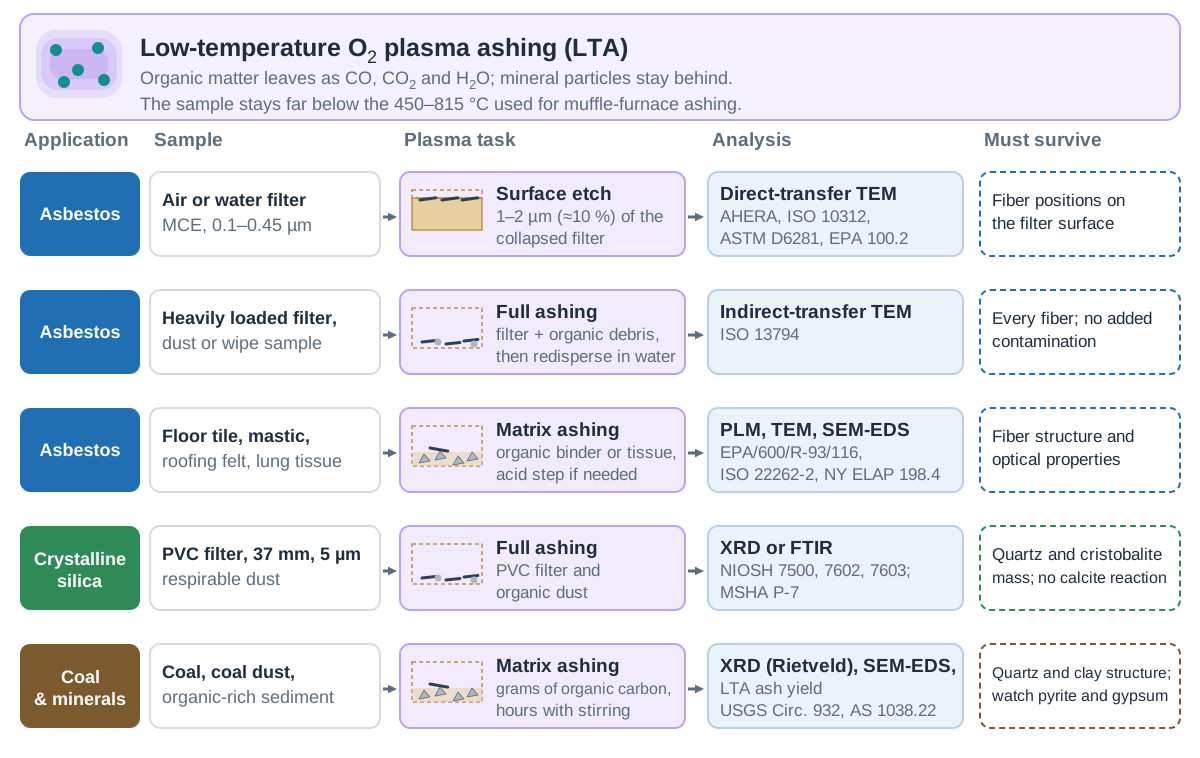
The same asher does three jobs: a shallow etch of a collapsed filter, complete ashing of a filter, and removal of grams of organic matrix. Each job has its own method and its own calibration.
| Method | Sample and analysis | Plasma step |
|---|---|---|
| AHERA (40 CFR 763), ISO 10312, ASTM D6281 | Asbestos in air on MCE filters; direct-transfer TEM | Required surface etch: remove a 1–2 µm (about 10 %) layer of the collapsed filter, with the time set by calibration |
| EPA Method 100.2 | Asbestos in drinking water; MCE 0.1–0.22 µm; TEM | Surface etch of about 10 % of the filter mass |
| ISO 13794 | Heavily loaded air filters; indirect-transfer TEM | Full ashing in oxygen plasma, then redispersion in water |
| EPA/600/R-93/116 | Bulk building materials; PLM, XRD, TEM | Matrix removal: plasma asher for small cellulosic samples, or a furnace at 300–500 °C |
| NIOSH 7500 | Respirable crystalline silica on PVC; XRD | Full ashing, then redeposition on a silver membrane (or furnace, or THF) |
| NIOSH 7602 | Respirable crystalline silica on PVC; FTIR (KBr pellet) | Full ashing in aluminum dishes (or furnace) |
| NIOSH 7603, MSHA P-7 | Quartz in respirable coal mine dust; FTIR | Full ashing in an oxygen-plasma asher (7603: 2 h at 300 W, 75 sccm O₂) |
NIOSH 7400 and 7402 do not ash the filter: an earlier revision of 7402 did, but the ashing step destroyed organic fibers and was removed. Always follow the method your laboratory is accredited for.
What the plasma has to do in each analysis
Asbestos, direct-transfer TEM
Collapsing an MCE filter buries some fibers in polymer. The plasma removes only the top 1–2 µm so they are exposed but stay in place. Too little hides short fibers; too much frees them. Low power or pulsed plasma stretches the etch to several minutes, which makes it easier to time.
Asbestos, indirect TEM and bulk
For overloaded filters, dust, wipes, floor tile, mastic and lung tissue, the plasma removes all of the organic material and leaves the fibers in a dry residue for redispersion, PLM or TEM. Low power and a cool sample limit fiber breakage.
Respirable crystalline silica
The PVC filter and organic dust would interfere with XRD or FTIR, so they are ashed away. Plasma ashing avoids the calcite–quartz reaction of a furnace; NIOSH authors regard plasma and furnace preparation as equivalent. Kaolinite survives LTA and needs the method's correction.
Ashing PVC releases HCl along with CO₂ and water. Tergeo systems use quartz chambers and are offered with oxygen-rated dry pumps or PFPE-oil pumps; follow the pump supplier's guidance on chlorinated by-products.
Membrane filter ashing and sample temperature in Tergeo systems
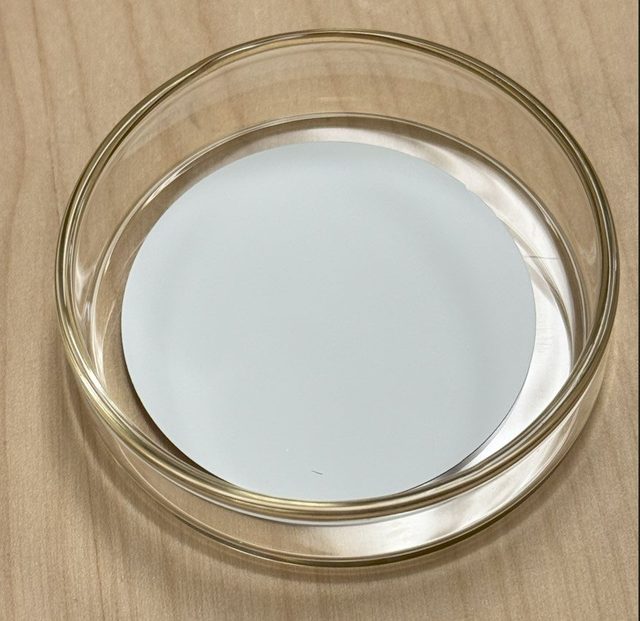
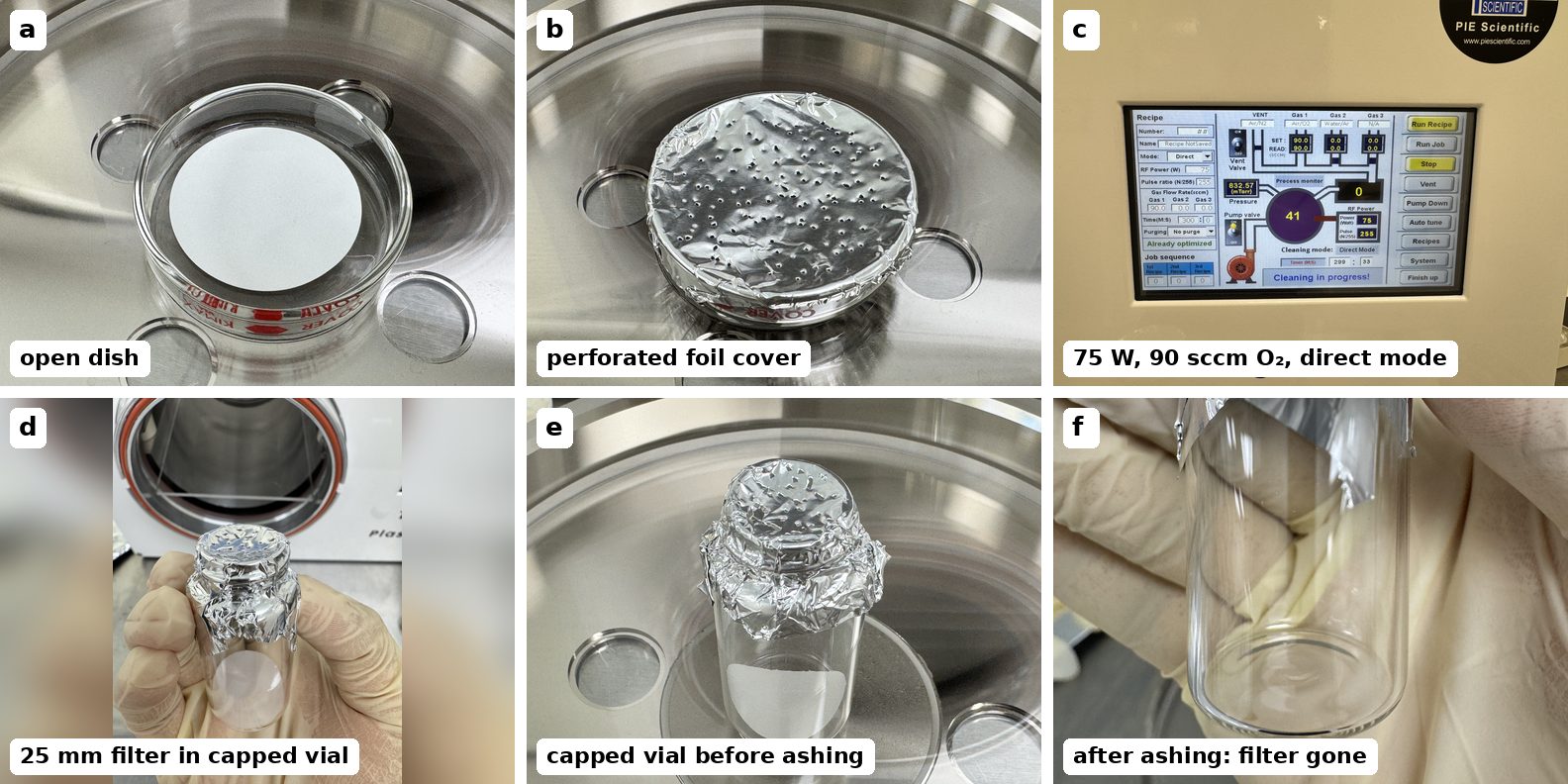
Tisch SF15103 cellulose acetate membrane filters (47 mm, 0.45 µm) were ashed in glass Petri dishes in Tergeo-series systems in direct mode, with a thermocouple under the dish.
| Sample and holder | RF power | O₂ flow | Ashing time | Emission end point | Rise under the dish |
|---|---|---|---|---|---|
| 47 mm filter, open dish | 30 W | 90 sccm | ≈20 min | 15.5 min | +8 °C |
| 47 mm filter, open dish | 15 W | 90 sccm | ≈60 min | 55.5 min | +6 °C |
| 47 mm filter, dish under perforated Al foil (Tergeo-Plus) | 75 W | 90 sccm | ≈20 min | — | not measured |
| 25 mm filter in a foil-capped glass vial (Tergeo-Plus) | 75 W | 90 sccm | 1–2 h | — | not measured |
What the data show
- Halving the power from 30 W to 15 W roughly tripled the ashing time, a simple way to slow the process down.
- The dish warmed by 6–8 °C, against the 100–200 °C reported for coal LTA in larger ashers and 450 °C and up in a furnace.
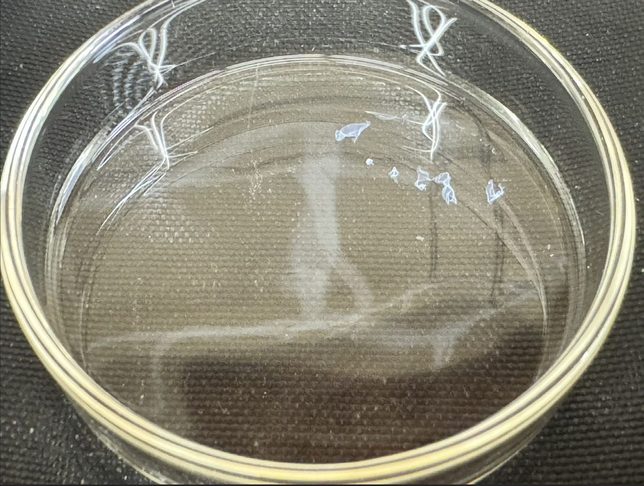
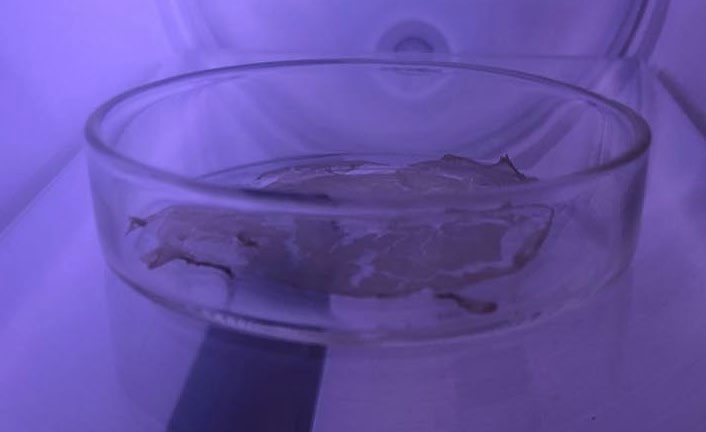
- Only a few flakes of very light residue remained. Slow venting kept them in the dish.
- A filter at the bottom of a foil-capped vial took 1–2 h, because oxygen atoms have to pass the foil holes and diffuse down the vial.
Cellulose acetate is one of the two esters in MCE filters, but these were not the MCE filters named in AHERA, and PVC filters have not yet been tested. A thermocouple under the glass reads lower than the filter surface. Treat these as starting points for your own calibration.
Bulk samples: about 1 g of coal or charcoal reached the end point in 3–6 h at 75 W
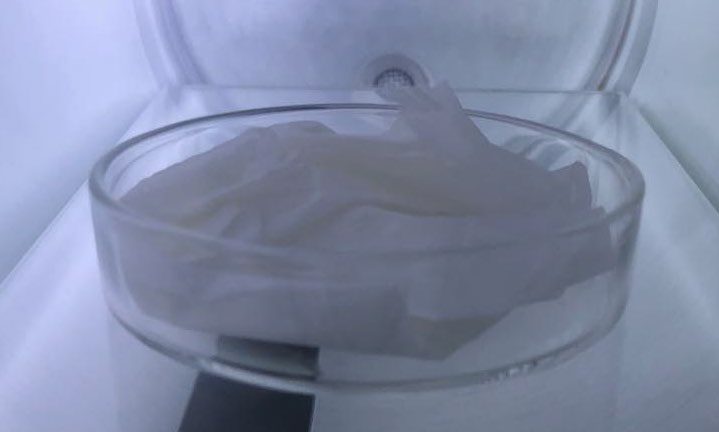
Cellulose-rich samples: the glow color shows the end point
Laboratory wipes stand in for wipe samples, paper and felt backings. Ashed overnight in argon plus oxygen, they left a small, porous mat of inorganic residue. The glow was whitish while water and CO₂ were released and turned violet, the color of the argon–oxygen plasma itself, when ashing was complete. Slow venting kept the residue in the dish.
Tips for low-temperature plasma ashing
- Calibrate where the samples sit. Ashing rate varies with position in the chamber; TEM laboratories repeat the calibration quarterly.
- Pump and vent slowly. Ash from filters and wipes is light enough to blow off a dish.
- Use pure oxygen and run blanks. A blank filter beside positive samples checks for carryover; run ash blanks for each new filter lot.
- Document the sample temperature once. An irreversible temperature label or a probe at the sample position, under your own recipe.
- Handle the residue as hazardous. Asbestos and silica are now in a light, easily dispersed form. Load and unload in a hood.
Tergeo plasma ashers
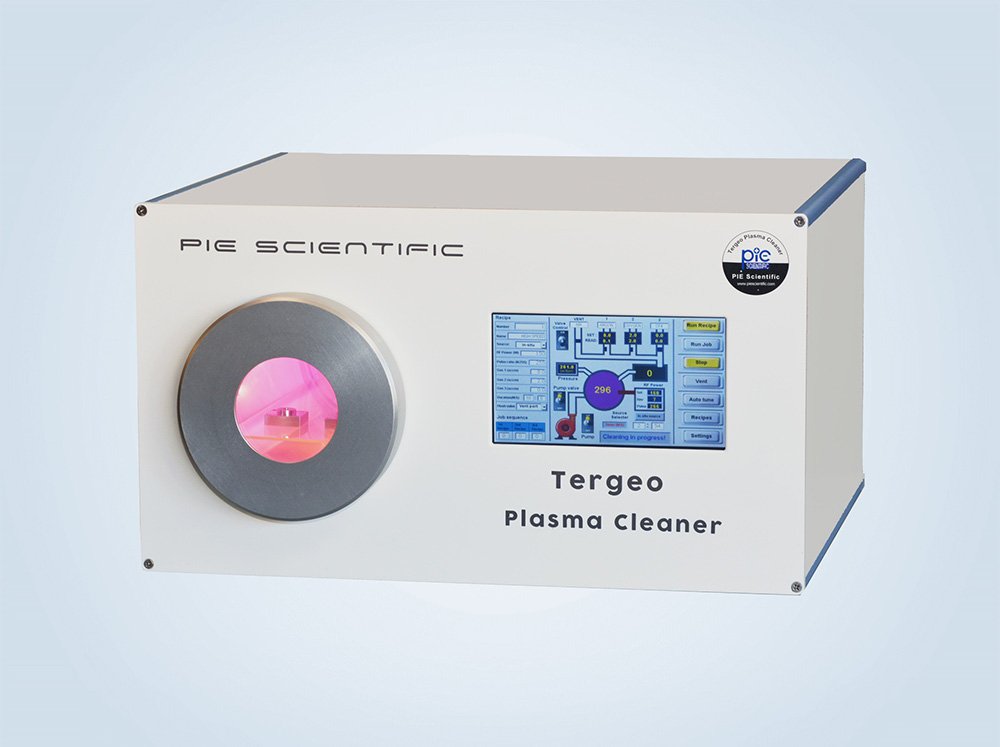
Quartz chambers, mass-flow-controlled oxygen, RF power from a few watts, pulsed plasma, slow pump and slow vent, and a plasma emission sensor for end-point detection on every system.
| Model | Quartz chamber | Suits |
|---|---|---|
| Tergeo | Ø110 × 280 mm | A few filters per run |
| Tergeo-Plus | Ø160 × 280 mm | Batches of dishes and vials; up to 500 W |
| Tergeo-Pro | Ø230 × 340 mm | Large batches, beakers and bulk samples |
Low-temperature plasma ashing questions
How hot does the sample get?
In our Tergeo tests the underside of the glass dish rose by 6–8 °C during membrane-filter runs at 15–30 W. Published coal-ashing work in larger ashers reports 100–200 °C, still well below furnace temperatures.
Why do AHERA and ISO 10312 require plasma etching of MCE filters?
Collapsing the filter buries some fibers in polymer. An etch of 1–2 µm exposes them without freeing them from the filter, so short fibers are counted.
Can plasma ashing replace a muffle furnace for silica analysis?
NIOSH 7500, 7602 and 7603 accept either preparation, and NIOSH authors regard the two as equivalent. Plasma ashing avoids the calcite–quartz reaction that a furnace can cause in coal-mine dust.
Does oxygen plasma damage asbestos fibers?
Asbestos minerals are silicates and do not burn. Studies on lung tissue found no significant change in fiber morphology or X-ray spectra after freeze-drying and plasma ashing. Fiber breakage comes mainly from handling and ultrasonic redispersion, not from the plasma.
How long does ashing take in a Tergeo?
About 20 min for a 47 mm cellulose acetate filter at 30 W, 1–2 h for a 25 mm filter in a capped vial at 75 W, and 3–6 h for about 1 g of coal at 75 W to the emission end point.
References
- U.S. EPA. Asbestos-Containing Materials in Schools, 40 CFR Part 763, Subpart E, Appendix A (AHERA TEM method). eCFR
- ISO 10312:2019 and ISO 13794:2019, Ambient air — Determination of asbestos fibres — Direct- and indirect-transfer TEM methods. ISO 13794
- R. L. Perkins and B. W. Harvey, Method for the Determination of Asbestos in Bulk Building Materials, EPA/600/R-93/116, 1993. PDF
- NIOSH Methods 7500, 7602 and 7603, NIOSH Manual of Analytical Methods. 7500 · 7602 · 7603
- MSHA, P-7: Infrared Determination of Quartz in Respirable Coal Mine Dust, 2024. PDF
- B. Gylseth, R. H. Baunan and R. Bruun, “Analysis of inorganic fiber concentrations in biological samples by scanning electron microscopy,” Scand. J. Work Environ. Health 7 (1981) 101–108.
- C. Viti, “Serpentine minerals discrimination by thermal analysis,” American Mineralogist 95 (2010) 631–638; R. Trittschack and B. Grobéty, American Mineralogist 98 (2013) 1133–1145.
- R. N. Miller, “The methodology of low-temperature ashing,” in U.S. Geological Survey Circular 932, 1984. PDF
- Q. Han et al., “Optimization of operating parameters for coal low-temperature ashing,” Minerals 12 (2022) 1119. MDPI
- M. Harper and R. J. Key-Schwartz, “Preparation of respirable crystalline silica samples for subsequent analysis,” Regul. Toxicol. Pharmacol. 83 (2017) 100–102.
- A. B. Somigliana, “Validation of freeze-drier/plasma asher method for analysis of asbestos in the lung tissue,” Frontiers in Chemistry 13 (2025) 1581910. Frontiers
Download the full application note
Low-Temperature Oxygen Plasma Ashing for Environmental and Occupational Analysis — mechanism, standard methods and Tergeo test data, with all figures and 70+ references (PDF, 25 pages, 2 MB).
Not sure which plasma cleaner fits your process?
Tell us your samples, size and process gas. Our engineers reply within one to two business days with a recommendation and a quote.