
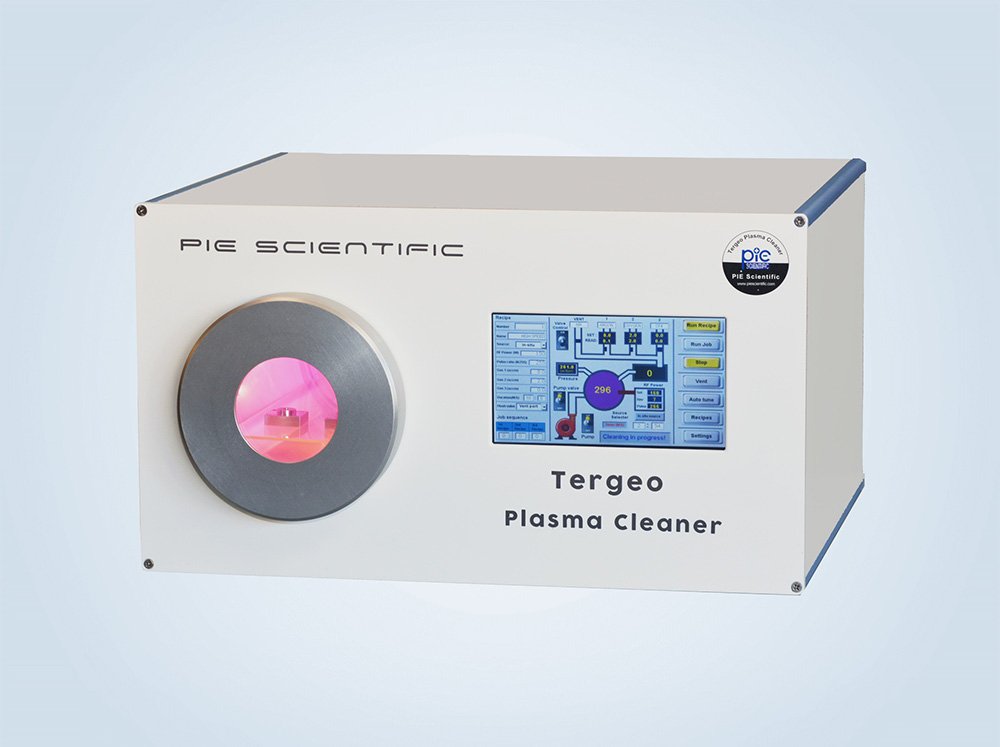
 Which Tergeo fits your lab?
Removing native oxide from metal thin films with hydrogen and argon plasma
A few nanometers of native oxide and adsorbed hydrocarbons are enough to raise contact resistance, weaken bonds and spoil the next deposited layer. Low-pressure hydrogen and argon plasma remove them at room temperature — gently enough for films only a few nanometers thick.
- Sub-3 nm Co: sheet resistance −25%
- InGaAs: O and C gone in 2 s (XPS)
- No wet etch, no heating
Why native oxide on metal films matters
Most metals grow an oxide within minutes of air exposure and collect a layer of airborne hydrocarbons on top. On a bulk part this is harmless; on a thin film or a contact pad it is often the weakest link.
Contact resistance
An insulating oxide between a metal film and a probe, wire or next layer raises — and destabilizes — contact and sheet-resistance readings.
Interfaces and nucleation
Oxide and carbon at the interface change how the next film nucleates and adheres, whether it is deposited by ALD, sputtering or evaporation.
Bonding and analysis
Tarnished bond pads reduce wire-bond pull strength, and surface oxide and carbon hide the true chemistry in XPS, AES and SIMS.
Chemical reduction or physical sputtering — choose by metal
Two plasma mechanisms remove a native oxide. Which one works depends on how stable the oxide is.
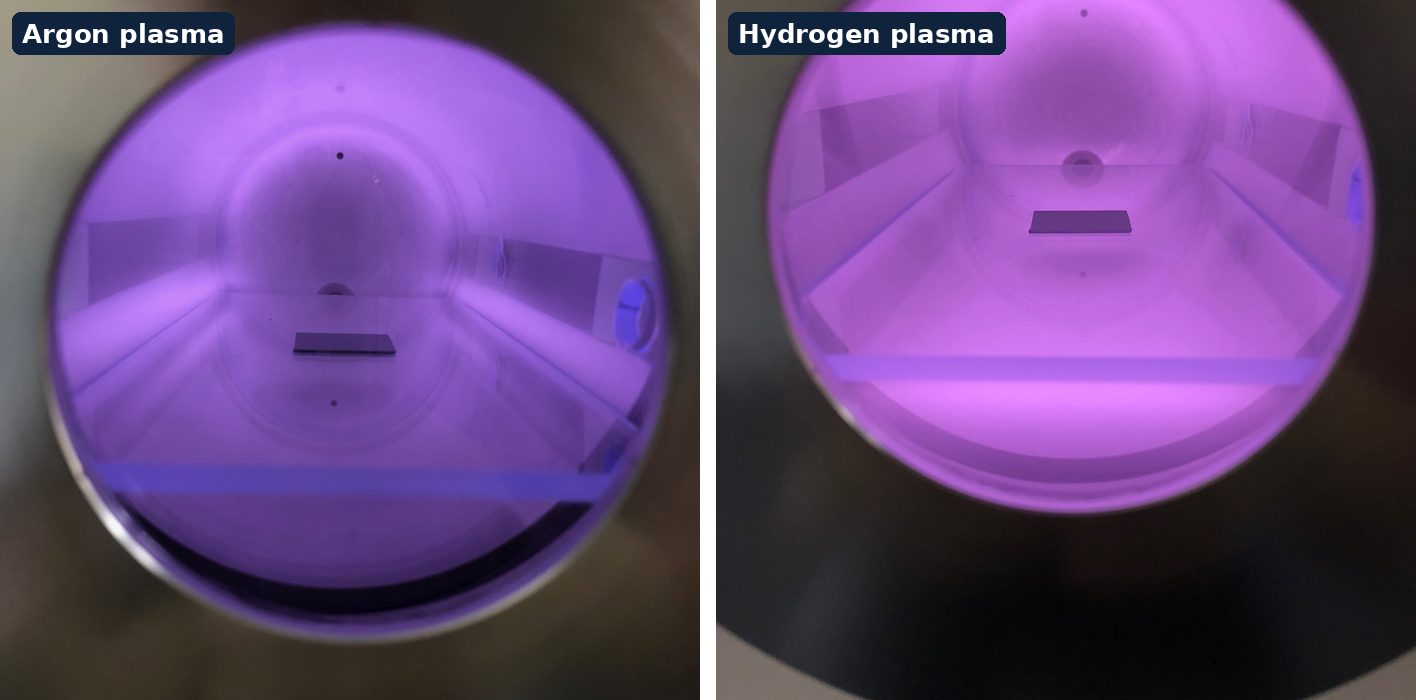
Hydrogen plasma: chemical reduction
Atomic hydrogen reacts with the oxide to form water vapor (for example CoO + 2H → Co + H₂O) and turns hydrocarbons into volatile species that the pump removes. No sputtering is needed, so it also works in gentle downstream (remote) mode — ideal for films only a few nanometers thick.
Argon plasma: physical sputtering
Argon ions knock the oxide and contamination off the surface. It works on any material, including oxides that hydrogen cannot reduce at room temperature, such as aluminum oxide. It needs direct (immersion) mode and removes material slowly, so power and time should be kept moderate on thin films.
Argon + hydrogen mixtures
Adding argon to hydrogen combines both effects and stabilizes the chamber pressure, because light hydrogen molecules are harder to pump at a steady rate.
| Material | Suggested plasma |
|---|---|
| Cobalt, copper, nickel, silver | H₂ or Ar + H₂; direct or downstream |
| Aluminum, titanium, tantalum, chromium | Ar (direct) — their oxides are too stable for room-temperature H₂ reduction |
| Gold, platinum | No native oxide; Ar or Ar + H₂ to remove hydrocarbons |
| III-V semiconductors (InGaAs, GaAs) | H₂, short and gentle |
| Avoid | O₂ or air plasma on any oxidation-sensitive metal — it grows oxide |
Starting points only — test on your own film and stack.
Sub-3 nm cobalt film: sheet resistance down by up to 25%
Customer-supplied 1 × 1 inch coupons with a cobalt film thinner than 3 nm, carrying native oxide and hydrocarbon contamination, were cleaned in a Tergeo plasma cleaner with argon, hydrogen and Ar/H₂ mixtures, in both direct and downstream modes.
Before cleaning, two-point resistance readings across the coupon were unstable, jumping from a few hundred ohms to the megaohm range — the signature of a discontinuous insulating oxide. Immediately after cleaning the readings were stable and about 30% lower (for example 370 → 250 Ω after 2 minutes of downstream hydrogen plasma).
The customer then measured sheet resistance with a four-point probe. Every condition with enough plasma energy lowered it, by 9–25%.
- Best: pure hydrogen, 150 W, direct, 5 min — −25%, consistent with chemical reduction of cobalt oxide
- Pure argon, 50 W, direct, 2 min — −16%
- Ar/H₂ mixtures and downstream mode — −9 to −12%, a gentler, ion-free process that still cleans
- Only one heavily pulsed 25 W run delivered too little energy and showed no change
| Mode | Gas (sccm) | RF, time | Rs change |
|---|---|---|---|
| Direct | H₂ 1 | 150 W, 5 min | −25.4% |
| Direct | H₂ 1 | 50 W, 5 min | −19.1% |
| Direct | H₂ 1 | 50 W, 2 min | −17.1% |
| Direct | Ar 10 | 50 W, 2 min | −16.4% |
| Direct | Ar 10 / H₂ 3 | 50 W, 6 min | −12.0% |
| Downstream | Ar 10 / H₂ 3 | 100 W, 4 min | −11.7% |
| Direct | H₂ 1 | 50 W, 1 min | −9.9% |
| Direct | Ar 20 / H₂ 10 | 150 W, 4 min | −9.5% |
| Downstream | H₂ 1 | 100 W, 2 min | −9.1% |
| Direct, 25 % pulse | H₂ 1 | 25 W, 5 min | no change |
Four-point-probe sheet resistance before → after; starting values 98–110 Ω/sq. MFC flows are air-calibrated: repeatable, but not absolute for hydrogen.
Measure soon after cleaning
The four-point measurements were made five to six days after cleaning, after shipping in sealed bags. A sub-3 nm cobalt surface re-oxidizes in air, so the 9–25% reductions are a conservative lower bound — the immediate two-point readings showed a larger drop. For the best result, measure or coat the film right after cleaning, or clean it in vacuum just before the next step.
InGaAs: oxygen and carbon removed in 2 seconds, confirmed by XPS
Researchers at UC San Diego cleaned InGaAs with a 2-second hydrogen plasma from a SEMI-KLEEN source mounted on the load-lock of their XPS system, then analyzed the surface without breaking vacuum. The oxygen and carbon peaks disappeared, while the indium, gallium and arsenic peaks of the clean semiconductor grew.
Relative XPS peak intensities. Data courtesy of Prof. A. Kummel, UC San Diego.
Cleaning in the load-lock avoids the re-oxidation seen in the cobalt test: the surface goes straight to analysis or the next deposition. The same approach suits metal films before ALD or sputtering.

Tarnished silver bond pads
Silver pads on chips and lead frames tarnish in storage, and the oxide and contamination weaken wire bonds. Three minutes of pure argon plasma removed the tarnish and the organic film: the pads became visibly brighter and wire-bond pull force improved significantly.


Getting reliable results on thin metal films
Start moderate
2–4 minutes at 50–150 W covered most of the effective cobalt conditions. Increase power or time only if the measured improvement stops short.
Use downstream mode for the thinnest films
Downstream hydrogen delivers reducing radicals with almost no ion energy, so a few-nanometer film is cleaned without being sputtered away.
Minimize air time
Measure, bond or coat right after cleaning — or clean in vacuum with an in-situ source on the load-lock of the deposition or analysis tool.
Systems: Tergeo and Tergeo-Plus benchtop plasma cleaners with Ar and H₂ gas lines (H₂, or a non-flammable Ar/H₂ premix); SEMI-KLEEN in-situ sources for load-locks. Related: hydrogen plasma cleaning · argon plasma cleaning
Metal oxide removal: common questions
Can plasma remove native oxide from metal films?
Yes. Hydrogen plasma chemically reduces oxides of metals such as cobalt, copper, nickel and silver at room temperature; argon plasma removes any oxide, including aluminum oxide, by sputtering. In our sub-3 nm cobalt test, pure hydrogen plasma lowered sheet resistance by 25%.
Hydrogen or argon — which should I use?
Use hydrogen (or Ar + H₂) where the oxide can be reduced and the film is very thin, because it works without ion bombardment. Use argon in direct mode for stable oxides like Al₂O₃, TiO₂ and Cr₂O₃, keeping power and time moderate on thin films.
Will plasma damage a film only a few nanometers thick?
Not with the right settings. The sub-3 nm cobalt film was cleaned in both direct and downstream modes and its sheet resistance went down, not up. Downstream hydrogen is the gentlest option.
How fast does the oxide grow back?
A clean, reactive metal surface starts re-oxidizing as soon as it meets air. Process or measure the film right after cleaning, or clean it in vacuum just before the next step.
Is hydrogen gas safe to use?
The flows are small (a few sccm) and the plasma runs at low pressure, but follow your site's hydrogen safety rules. A non-flammable argon/hydrogen premix is an alternative where pure hydrogen is not allowed.
Download the full application note (PDF)
Hydrogen/argon plasma cleaning of a sub-3 nm cobalt thin film — native-oxide and hydrocarbon removal verified by surface contact resistance. 5 pages: method, all conditions, measurement timing and discussion.
Not sure which plasma cleaner fits your process?
Tell us your samples, size and process gas. Our engineers reply within one to two business days with a recommendation and a quote.