
 Which Tergeo fits your lab?
Plasma bonder for microfluidic devices
Permanent, leak-free PDMS–glass and PDMS–PDMS bonds in seconds. Tergeo plasma bonders activate both surfaces with oxygen, air or water-vapor plasma under precise, repeatable recipe control.
- Contact angle ~110° → below 10°
- Bonds stronger than bulk PDMS
- Water-vapor plasma kit

What a plasma bonder does
PDMS is covered with non-polar –CH₃ groups that will not bond. Oxygen plasma replaces them with silanol (–Si–OH) groups; glass gains extra silanol groups too. Pressed together, the –OH groups condense into covalent siloxane (Si–O–Si) bonds that are stronger than the PDMS itself.
Adding water vapor to the plasma produces more OH* radicals and a surface that stays hydrophilic longer — especially helpful for PDMS-to-glass bonding.

PDMS–glass bonding in a Tergeo plasma bonder
Clean glass
IPA, then DI water; blow off droplets — no heat gun, trace moisture helps.
Prepare PDMS
Dust-free surface: low-residue tape or an IPA rinse.
Plasma
Oxygen, air or O₂ + H₂O plasma; use low-intensity or pulsed recipes to avoid over-oxidation.
Bond at once
Place PDMS on glass immediately and press gently to remove bubbles.
Strengthen
Optional 10–30 min at 80 °C on a hot plate or oven.
Plasma bonders

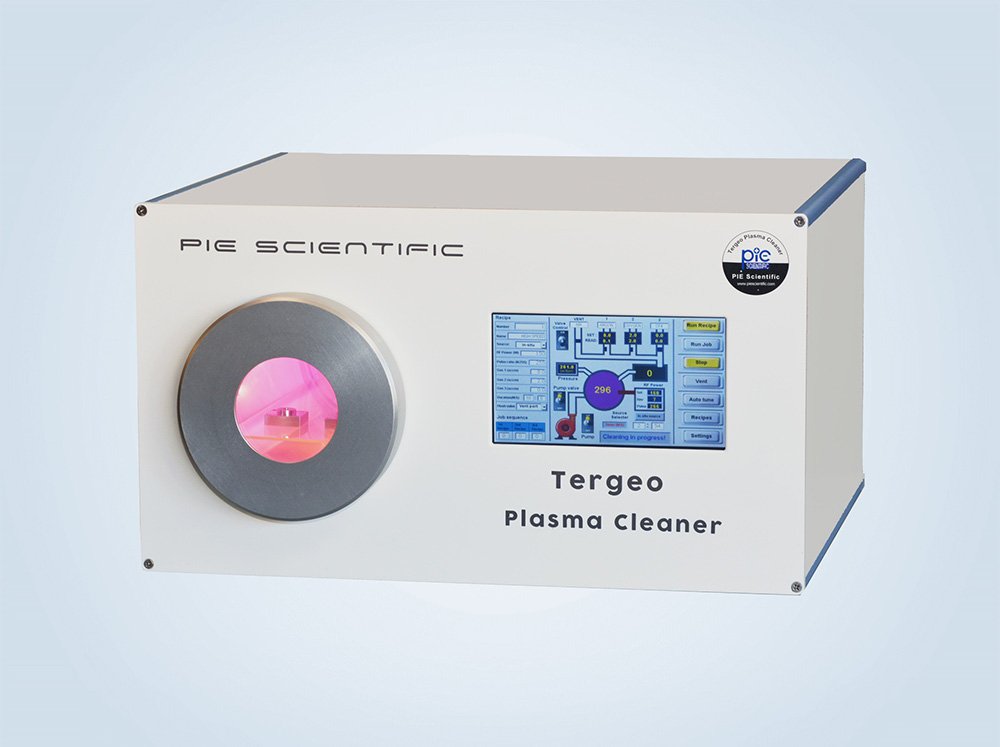
Tergeo
Ø110 mm chamber — slides, chips and most microfluidic devices.
Details →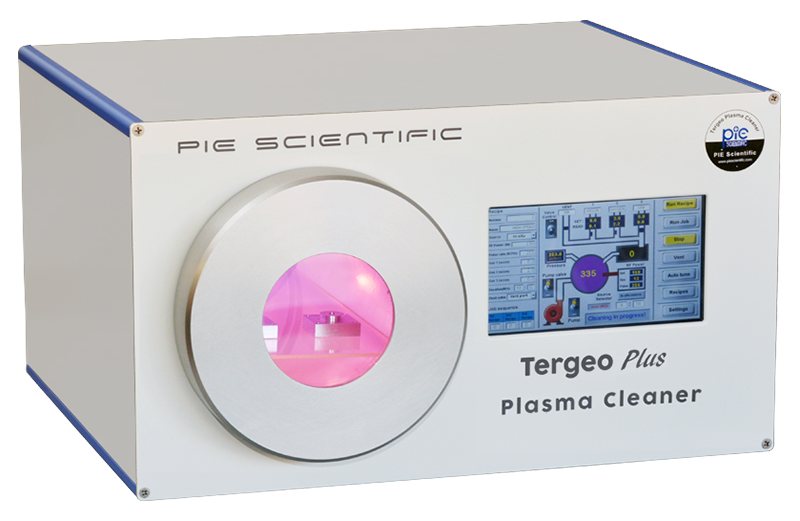
Tergeo-Plus
Ø160 mm chamber for wafer-scale devices and multiple slides.
Details →Water-vapor plasma kit
A special MFC delivers about 10 sccm of water vapor at room temperature for consistent, repeatable OH-rich plasma.
Ask about the kit →The Tergeo cleaner allows us to realize a simple PDMS‐glass bonding process in a very efficient way. The treatment works very well and a curing step in an oven to improve the bonding efficiency is no longer needed.
 Dr. Marc FouetMolecular & Cell Biology, UC Berkeley
Plasma bonder questions
How long should I plasma-treat PDMS before bonding?
Typically 10–60 seconds of oxygen or air plasma. Too much plasma over-oxidizes PDMS and weakens the bond, so start low and use pulsed mode if needed.
How long after plasma treatment can I still bond?
Bond immediately. PDMS recovers its hydrophobicity over time as polymer chains reorient and low-molecular-weight siloxanes migrate to the surface.
Can I bond PDMS to plastics like COC, PMMA or PC?
Plasma alone gives weaker bonds to these polymers. Combining plasma with silane coupling agents (for example APTES and GPTMS) gives strong bonds; see the PDMS bonding guide.
Do I need a heat step?
PDMS–glass and PDMS–PDMS bond at room temperature within minutes; 10–30 minutes at 80 °C strengthens the bond further.
Not sure which plasma cleaner fits your process?
Tell us your samples, size and process gas. Our engineers reply within one to two business days with a recommendation and a quote.