
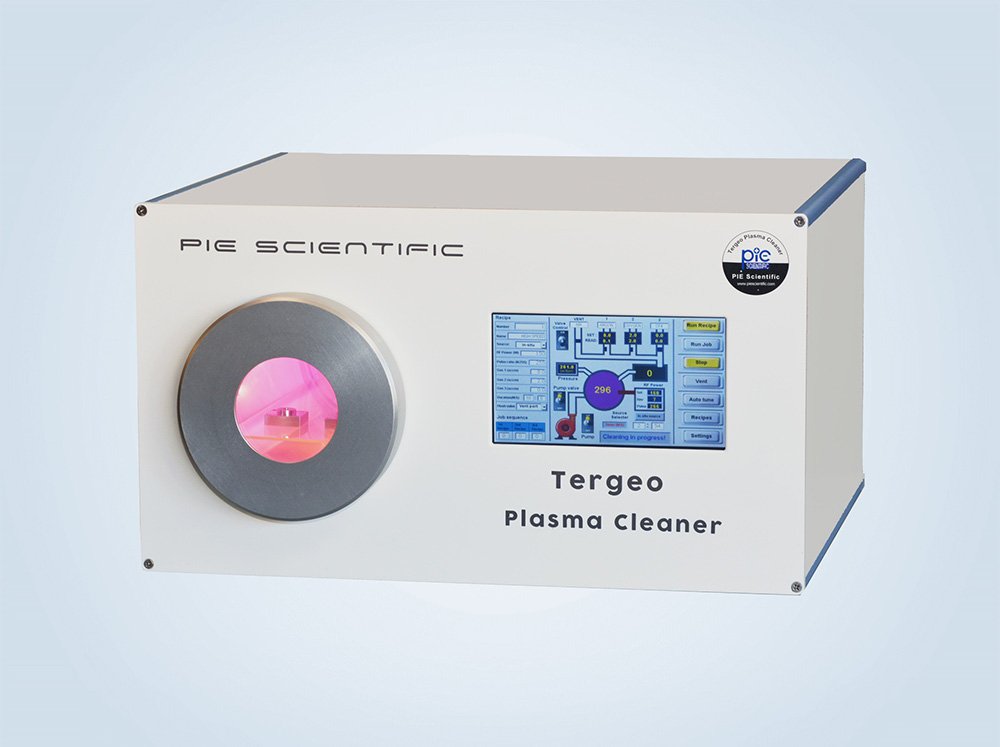
 Which Tergeo fits your lab?
Sample and chamber plasma cleaning for film-coating equipment
SEMI-KLEEN in-situ plasma cleaning for ALD, evaporation and sputter tools — prepare samples in the load-lock and keep process chambers clean, so the film grows on the substrate, not on residue.
- Gentle — no ion damage
- H₂ plasma: oxide & carbon off in seconds
- Fits a spare CF or KF port
A clean interface is the first layer of every good film
Native oxide, adventitious carbon and photoresist residue left on a substrate become defects, poor adhesion and high contact resistance in the finished film. Cleaning inside the vacuum system — right before deposition — removes them without re-exposing the sample to air.
Gentle surface cleaning
Downstream radicals clean samples and chamber walls without ion bombardment — no sputter damage to delicate substrates or devices.
Oxide and carbon off in seconds
Hydrogen plasma strips native oxide and carbon, leaving a fresh surface for the next film.
Cleaner interface, fewer defects
The film nucleates on the substrate, not on residue — better adhesion, uniformity and electrical contact.
Descum before lift-off
O₂ plasma removes photoresist scum in the load-lock right before lift-off deposition.
Wide chemistry choice
O₂, H₂, NF₃, NH₃, Ar, He, N₂, CDA and mixtures — matched to the material and the contamination.
OEM-ready
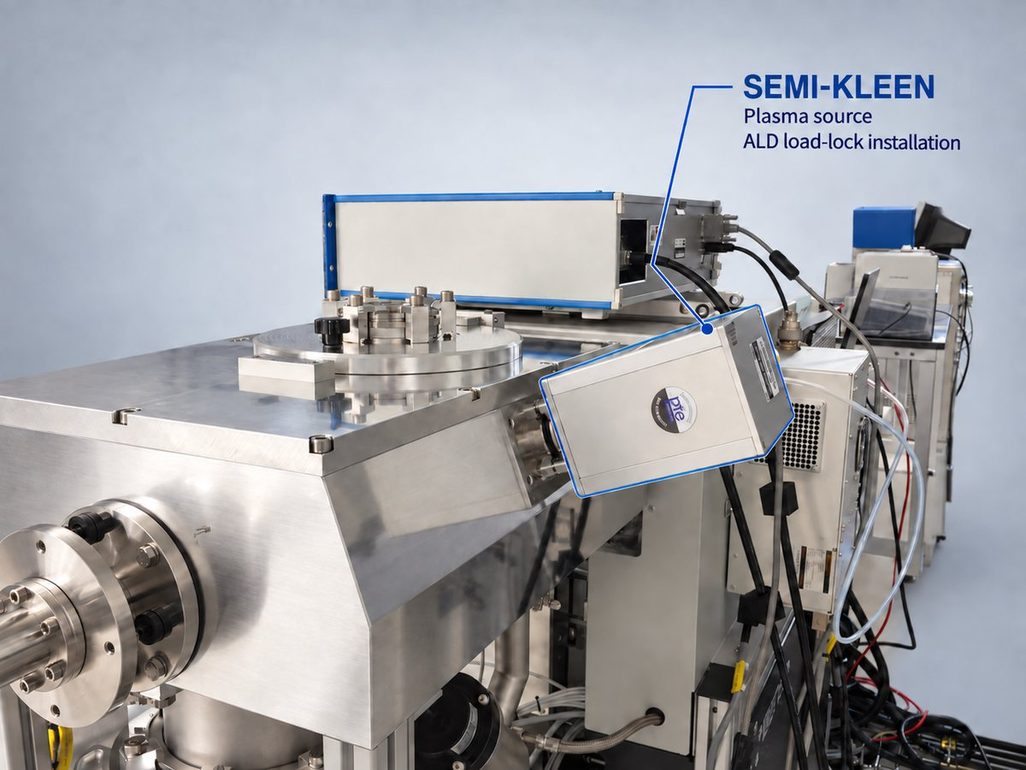
Fits a spare CF or KF port of the load-lock or process chamber; controller with touchscreen and 60 recipes, or remote control from the tool.
Sputter, evaporation and ALD systems
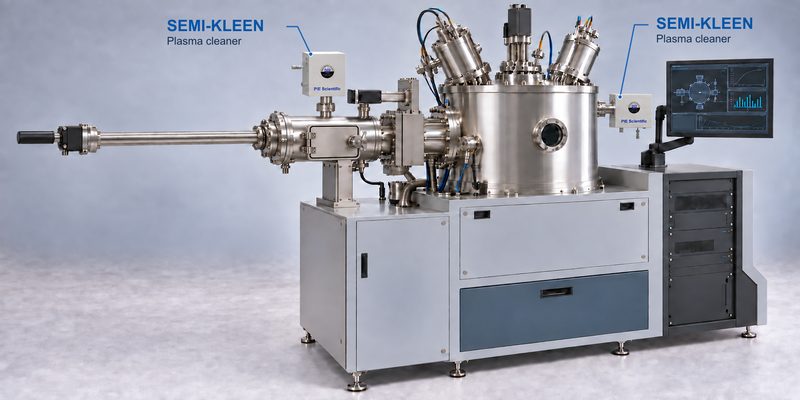
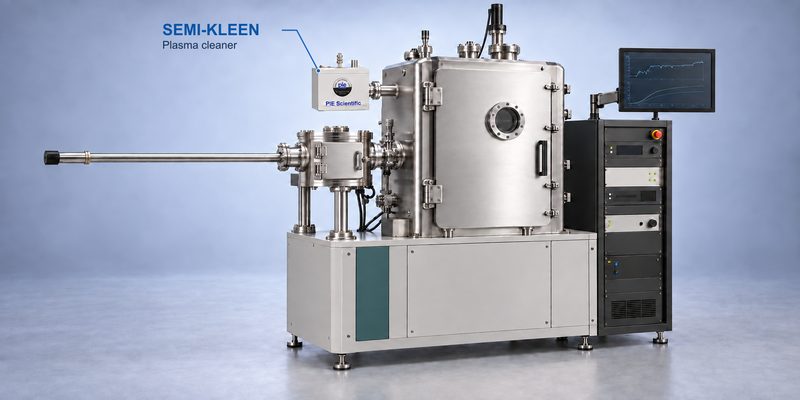
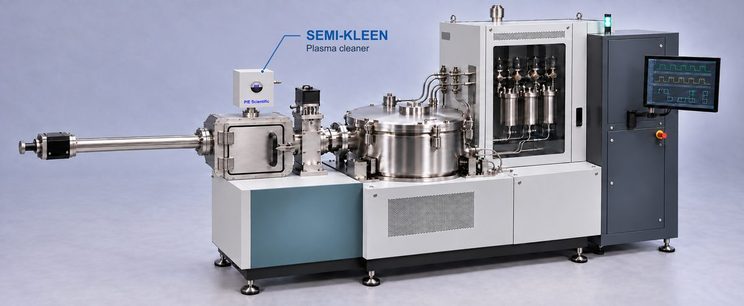
Illustrations show generic tools; SEMI-KLEEN is supplied to coating-equipment makers as an OEM component and as a retrofit for installed systems.
InGaAs after 2 seconds of H₂ plasma
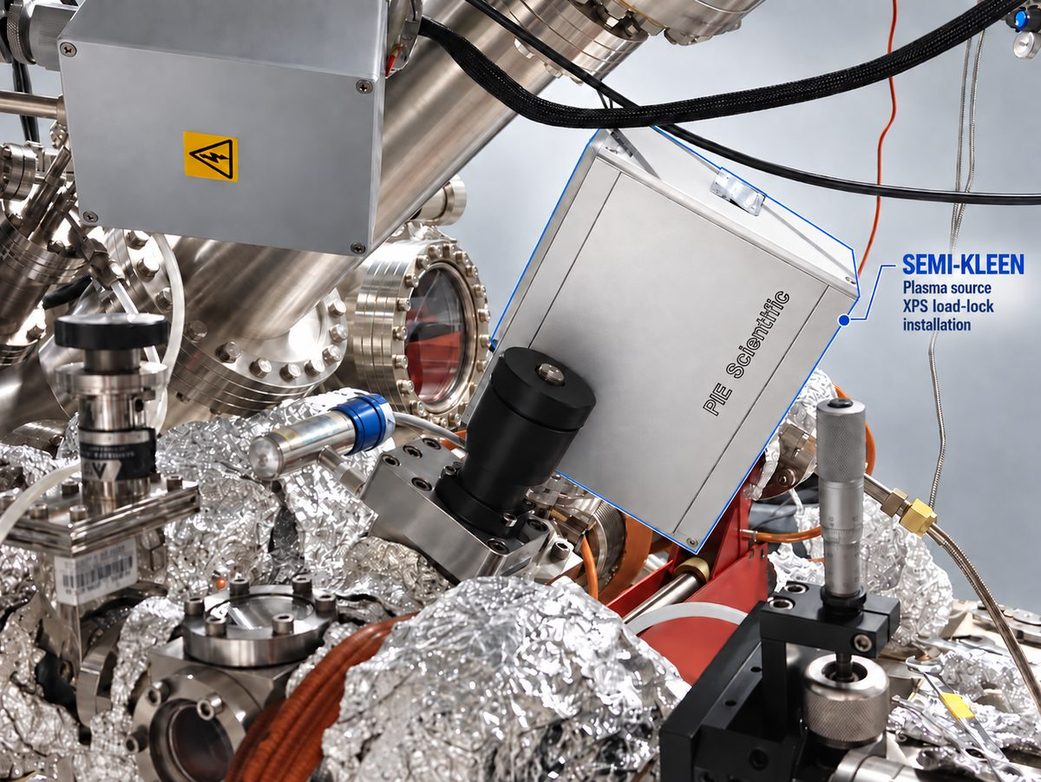
XPS of an InGaAs surface before and after a 2-second hydrogen plasma from a SEMI-KLEEN source mounted on an XPS load-lock. The oxygen and carbon signals vanish and the substrate peaks (In, Ga, As) come up.
Relative XPS peak intensities. Data courtesy of Prof. A. Kummel, UC San Diego — SEMI-KLEEN on an XPS load-lock.
Which plasma for which job
| Goal | Typical plasma | Notes |
|---|---|---|
| Remove native oxide (III-V, Si, metals) | H₂, NF₃, NH₃ | Fluorine and hydrogen-rich chemistries use SEMI-KLEEN Sapphire |
| Remove adventitious carbon | H₂ or O₂ | H₂ for oxidation-sensitive surfaces; O₂ where a thin oxide is acceptable |
| Photoresist descum before lift-off | O₂, O₂/Ar | Low power, short time, run in the load-lock |
| Chamber and shield cleaning | O₂, CDA, H₂ | Removes hydrocarbon background; speeds pump-down |
| Surface passivation / nitridation | N₂, NH₃ | Process-specific — ask our engineers |
Thin-film deposition & surface analysis applications · Hydrocarbon removal on XPS, SIMS, AES
Plasma cleaning in deposition tools
Where should the plasma source be mounted — load-lock or process chamber?
For sample preparation, the load-lock is usually best: the sample is cleaned and transferred under vacuum straight into deposition. For chamber conditioning and hydrocarbon background, mount it on the process chamber. Both use a spare CF or KF port.
Will the plasma damage my substrate or device?
SEMI-KLEEN is a downstream source: ions stay in the source and only neutral radicals reach the sample, so there is no ion bombardment or sputter damage.
Can the deposition tool controller run the cleaning step?
Yes. Recipes can be called over RS-232/RS-485, so pre-cleaning becomes a step in the deposition recipe.
Do you work with equipment manufacturers?
Yes — SEMI-KLEEN is supplied as an OEM component to film-coating and surface-analysis equipment makers. See the OEM program.
Not sure which plasma cleaner fits your process?
Tell us your samples, size and process gas. Our engineers reply within one to two business days with a recommendation and a quote.