
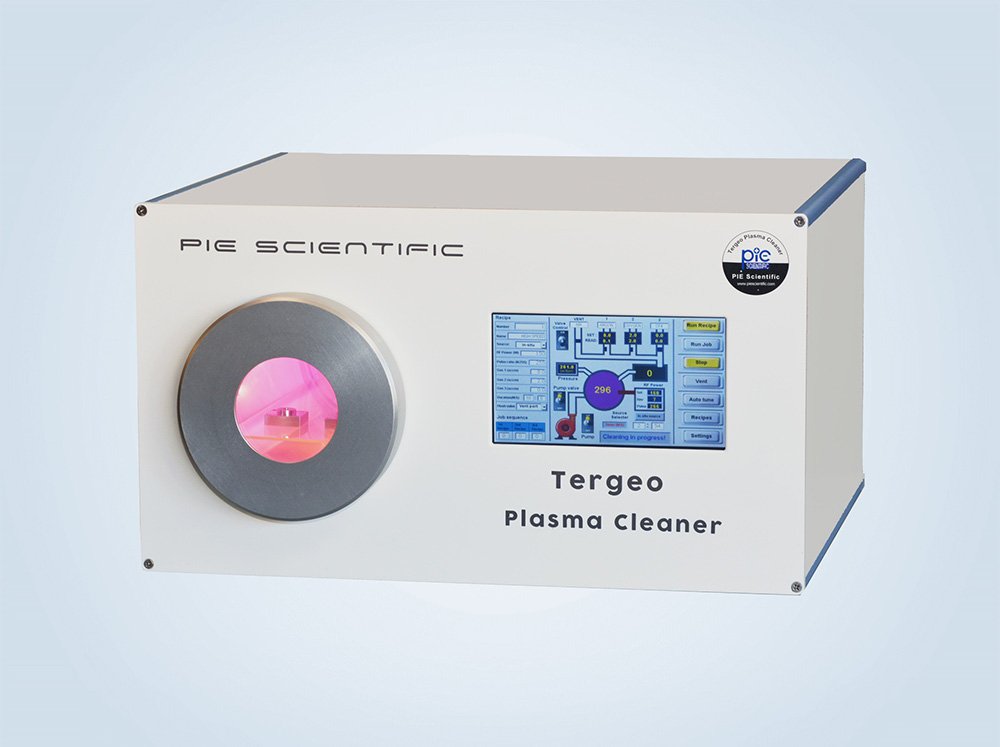
 Which Tergeo fits your lab?
Plasma surface treatment equipment
Increase surface energy, wettability and bond strength on polymers, glass, metals, ceramics and PTFE — with a tabletop vacuum plasma surface treatment system you can run in any lab.
- Hydrophilic or hydrophobic on demand
- Treats the whole 3D part
- O₂, Ar, N₂, air, H₂O, H₂, CF₄

What the equipment does
Plasma surface treatment exposes a part to a low-pressure gas plasma. Reactive radicals and ions remove the invisible organic film that blocks adhesion and graft polar groups (–OH, C=O, –COOH) onto the surface. Surface energy rises, water contact angle drops, and glues, coatings, inks and cells bond far better — without primers or solvents.
- Adhesion & bonding: epoxy, adhesives, PDMS–glass, polymer–metal
- Wettability: hydrophilic for microfluidics and cell culture; hydrophobic with fluorine plasma
- Coating & printing: better paint, ink and biomedical coating adhesion
- Cleaning: removes oils and residues before any of the above
New to it? What is plasma surface treatment
Read the full guide: plasma surface treatment process & mechanism

Plasma surface treatment for every material
| Material | Typical plasma | Result | Learn more |
|---|---|---|---|
| Polymers & plastics (PC, PET, PP, PVC, PMMA, COC) | O₂, air, N₂ | Higher surface energy; stronger adhesive, ink and coating bonds | Polymers |
| PDMS & glass | O₂, air, O₂ + H₂O | Covalent Si–O–Si bonding for microfluidic devices | Plasma bonder |
| PTFE, PFA, FEP (Teflon) | H₂, H₂O + O₂ | Bondable, wettable fluoropolymer surfaces | Fluoropolymers |
| Metals (Ti, Al, stainless, Cu) | Ar, Ar + H₂, O₂ | Clean, activated surfaces for epoxy bonding and wire bonding | Metal bonding |
| Silicon, oxides, glass slides | O₂, H₂O | Super-hydrophilic surfaces; organic-free substrates | Silicon wafers |
| Medical implants & devices | O₂, H₂O, N₂ | Controlled wettability, better coating adhesion, sterilization | Medical devices |
| Graphene & 2D materials | O₂, H₂, N₂ (downstream, pulsed) | Gentle functionalization and doping without destroying the lattice | 2D materials |
Why labs choose low-pressure plasma surface treatment
Uniform on 3D parts
The plasma fills the chamber, so every face, cavity and channel is treated — not just what a nozzle can see.
Choose the chemistry
Three MFC gas lines: oxygen and water vapor for hydrophilic, argon for metals, hydrogen for PTFE, CF₄ for hydrophobic.
Gentle to aggressive
Downstream radicals and pulsed plasma for delicate films; direct mode when you need roughening or fast cleaning.
Repeatable results
Recipe control, a plasma intensity sensor and MFC flow give the same treatment run after run.
Longer-lasting hydrophilicity
Water-vapor plasma creates a dense OH* layer that resists hydrophobic recovery.
No solvents, no primers
A dry, clean process that produces mainly CO₂ and H₂O.

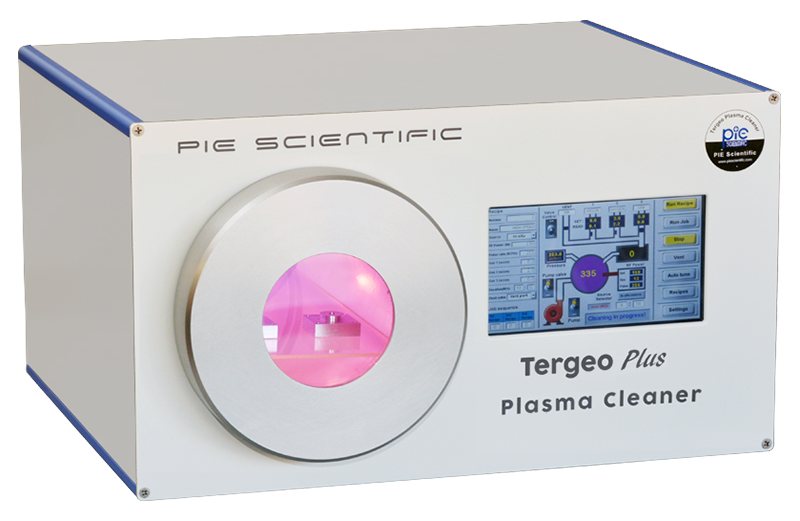

Plasma surface treatment questions
What is plasma surface treatment?
A dry process that uses a gas plasma to clean a surface and change its chemistry, raising surface energy so adhesives, coatings, inks and other materials wet and bond well. A short introduction with diagrams.
How long does plasma surface treatment last?
Treated polymers slowly recover toward their original hydrophobic state over hours to days. Bond, coat or print soon after treatment; water-vapor plasma gives a more stable hydrophilic surface.
Can plasma make a surface hydrophobic?
Yes. Fluorine-containing plasmas such as CF₄ deposit fluorinated groups that lower surface energy and repel water.
Vacuum or atmospheric plasma surface treatment?
Atmospheric jets suit inline treatment of large flat parts. Vacuum plasma treats complex 3D parts uniformly, offers more gas chemistries and gentler modes, and is the standard in labs and medical-device development. See vacuum vs atmospheric plasma.
Which gas and recipe should I use for my parts?
Tell us the material, part size and what you need to bond or coat, and our engineers will recommend a gas, power and time to start from. Contact us.
Not sure which plasma cleaner fits your process?
Tell us your samples, size and process gas. Our engineers reply within one to two business days with a recommendation and a quote.